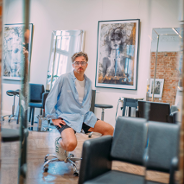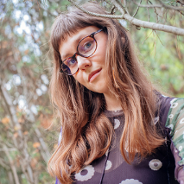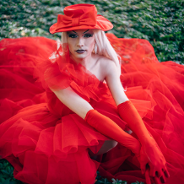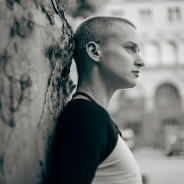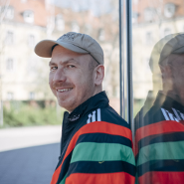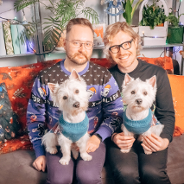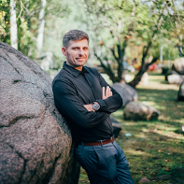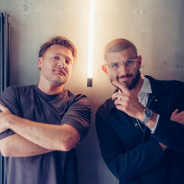
How long have you two been a couple?

Robert: Five years.

I thought it has been longer.

Michał: I also feel like it's been twenty years or so.

Was it love at first sight?

Robert: Definitely!

Michał: We had to sort out our previous lives pretty fast, and yeah, there was collateral damage, a few people definitely got hurt.

Robert: That's because we were both in relationships when we first met. And actually, it was more like love at first handshake rather than first sight. Has Michał given you one of his handshakes yet?

Did you like his firm grip?

Robert: Didn't you?

Very much so.How did you two meet?

Michał: I was opening a restaurant called Orzeł i Reszka in the Jeżyce district, and Robert turned up at the launch. He walked over to me with two empty glasses, I poured him some wine and asked if there was anything else I could do for him.

Robert: Michał likes to think I fell for him right there and then, but that's not quite how it went down. What really brought us together was his bank loan. I mean, Michał had a mortgage, and I'm a lawyer who specialises in Swiss franc loans. So he came to my law firm and that's how it all started.

Michał: Or you could mention how, after that, you started showing up at Orzeł i Reszka every morning for breakfast - even if it meant going out of your way.

Robert: As you can see, we've each got our own version of the story.

Michał: But we can agree that you started liking my every post.

Robert: Rubbish, you were the one liking all mine. Then the endless messaging started, and before we knew it, we were sneaking off to meet in secret.

Michał: Three months later, we were already living together.

Have you always lived in Poznań, or did you choose it as your home?

Robert: I was born in the Raszeja hospital. My first home was on ul. Paderewskiego, in a tenement that later became a squat, right by the Old Market Square. Later, my parents and I moved to the Piątkowo district and became your classic estate family. Michał's originally from Pleszew, but he's lived in Poznań for twenty years now. His mum and her side of the family are from here too.

Where did you move to when you became a couple?

Michał: Naramowice. Together with Antek, Robert's French bulldog, we made quite the trio. It was a brilliant time, though I did have to change quite a few habits. In my previous relationships, even the long-term ones, we kept a lot of things separate, including money. I think that's quite common in gay relationships. Robert, however, was baffled by that. To him, being together means sharing everything in life.

Robert: That's always been my view. So I set out to convince Michał there was nothing to worry about. I think it took us about a year to really gel, and now we share everything. Our mate - probably the best notary in Poznań - essentially gave us what one could describe as a wedding. We drew up a civil agreement that ties everything together, as far as Polish law allows.

Michał: Having sorted all that with the notary, we went out for lunch, and that's when I produced the rings.

Robert: You know, those little ones from Tymbark soda bottle caps.

The ones you're wearing now?

Robert: Are you crazy? These are Cartier!

Michał: It was the gesture that mattered - I thought it was romantic.

Robert: And it was! But we couldn't exactly wear those forever. We're Poznań gays, we've got standards.

How long had you been together when you sorted out the paperwork and rings?

Michał: About a year and a half, so it wasn't long.

Robert: It took us even less time, six months since we moved in, to find our dream house in the Grunwald district. And, the best bit, we managed to buy it two years later. We're in the middle of a major renovation now and I'm hoping we'll move in by the end of next year.

It all sounds very heteronormative!

Michał: I don't think it's about chasing some heteronormative ideal, even if it may look that way. For us, it's always been about just being together. In five years, we've barely been apart for...

Robert:...fourteen days.

Michał: Twelve. Either way, we're rarely apart and we love it that way. Sometimes it does mean seeing less of our friends or family. I miss Robert even if he's off to Warsaw for just one night. When he's not around, I feel lost, pottering around the house not quite knowing what to do with myself.

Yours is the kind of story many queer parents would dream of: a solid relationship, stability, shared goals.

Robert: We both come from families where our dads - while not thrilled - accepted us being gay, as long as it wasn't spoken about openly. My dad knew I was with a man. He spent so much time at our place that he might as well have lived there. When my mum passed away, he sort of stepped into her role. But it was never said out loud that this was my partner. Later I was with a guy who stayed closeted for years, hiding his sexuality from his loved ones, and it was utterly exhausting. I honestly couldn't go through that again. Keeping your sexuality hidden is no longer on the table.

Michał: If we feel like holding hands in town, we do it, and it's nobody else's business. And to be honest, I can't think of any bad reactions we've had in Poznań.

What do you usually call each other?

Robert: When I'm trying a shirt on in a shop and I'm not sure if I like it, I'll just say my husband's coming in a minute, and we'll decide together.

Michał: I honestly can't remember the last time I felt the need to hide who Robert is. Even when I'm chatting with builders, I'll just say, "Let me check with my husband".

Robert: Naturally, the builders assumed we were business partners doing up the house for an office.

Michał: Same story in restaurants or hotels. When we say we're a couple, people often think we're joking. It takes a bit of effort to convince them we're serious.

It's interesting how gender stereotypes come into play. You're both quite masculine - people might not "clock" you as gay at first glance. Even when you hold hands in the street, few people would have the guts to confront you.

Michał: I think you're right. And the way we dress adds to it. Every time Robert shows up at the building site wearing a suit, the tone of conversation changes. I've got a deep voice, which helps sort things out on the phone.

Robert: Definitely. I've lost count of how many times women have said to me, "I'd never have guessed you're gay." That just makes us more determined to walk around town holding hands, shaking things up and challenging people's assumptions. That's kind of a mission of ours.

Does Poznań differ from other cities in that respect?

Robert: It does, slightly. But it's not hugely different from other Polish cities we frequent, such as Warsaw, Wrocław, or the Tri-City. We don't really venture further east, you won't catch us in Lublin, for example.

Michał: Which is a shame, really. It's like the Vistula splits Poland into two very different worlds.

Robert: What matters is that we're on the right side of it. Poznań's a brilliant place to live, arguably Poland's most gay-friendly city. We joke that it's run by a gay mafia. We've realised we don't even need to fly a rainbow flag outside our next restaurant in Jeżyce -every venue here is gay friendly. And if it's not, we joke that the security guards are our gym mates. Once, one of them came up to me and said: "I don't usually like fags, but you lot are alright." Then he just walked away.

Michał: Another time at a gym, some jacked guy started chatting to us: "Oi, don't you two run a restaurant?" I said yeah. And he goes: "All veggie, isn't it? Hehe." And Robert instantly quipped, loud as can be: "Not all poofs are veggie!" The whole gym burst out laughing.

How long did it take you to reach that level of confidence?

Michał: The turning point for me was leaving Pleszew. I moved to Wrocław to study veterinary medicine, and that's when things really kicked off - I started living a gay life openly. I came  out to my mum and sister at sixteen.

Robert: Michał's mum had a bad accident in Germany and was hospitalised for ages. His dad was often there visiting, staying in a flat owned by a lesbian couple, one of them Polish and working with an organisation that helped Poles in need.

Michał: I came out to my dad much later, when I was already in a long-term relationship. One day, I just brought my partner home for Sunday lunch. "Nice to have all my kids under one roof," my dad said when we arrived. I think he actually loved Robert more than me.

Robert: Same with my dad - he loves you. Though at first there was a bit of drama, because my dad was somewhat confrontational, a classic alpha male. But when Michał shook his hand, everything shifted. I think what helped with our dads is that we can have a laugh about being gay and are not strict about political correctness. For us, being gay isn't taboo, nothing is off limits. Our dads are actually very much alike. When both our families went away together for Easter, and later on a mushroom picking trip, our dads hit it off straight away.

Michał: We even hosted Christmas Eve dinner once - all thirty-six family members, and it was a hit.

Robert: And sometimes I wonder if there's anything left to argue about now that a new generation has taken over. When a trans kid joined my brother's class, we gave him a fifteen-minute lecture on what to say, what not to say, and how to behave. He listened, all patronising, then asked if we were alright - because to him what we were saying was obvious. We really did come across as a pair of grumpy old men.

You mentioned you're always together and that part of that is down to your work - you own three restaurants: Roberto (in Jeżyce and Old Brewery Park) and Berlin Ecke (also in Jeżyce). Does being so inseparable 24/7 - both privately and professionally - ever get old?

Robert: It wasn't something we planned - it just evolved that way. We built our first place together, Światłocień Jeżyce, from the ground up, even though I'd never been in the restaurant business. I guess somewhere deep down, I'd always wanted to try it - and you always pursue your dreams. Then more venues cropped up, and now our lives and work are totally intertwined. It's not without its challenges - we're learning how to take proper breaks, which is harder than it sounds. We've bought a camper van that is parked by the sea to get away from it all with our dogs, though naturally, Michał is already thinking about opening a restaurant there.

Michał: And immediately Robert said he wouldn't be able to bear me running it solo, so he'd be popping down every fortnight to collect the takings.

How many places have you opened altogether?

Michał: Besides the ones we've mentioned, there was Tapasta and two Święta Krowa locations - one on ul. Kościelna and one on ul. Kwiatowa. All told, I've been in the restaurant business for over twelve years. I originally studied veterinary medicine, then switched to economics at the University of Economics in Poznań. But cooking came about because of family - the most important thing was always sitting down together at the table. It was my mum who taught me to cook, and she was brilliant at it. Then I took some cookery courses, and the rest is history. I dipped into my savings, went to Warsaw, stayed with a friend, and visited restaurants all day with a notebook. I brought all that knowledge back to Poznań and opened Święta Krowa. I was up to my ears in work, but happy to see it all working out brilliantly.

Five years in, is there still a spark between you?

Robert: Definitely, although you have to work at it a bit more, which is probably normal. What matters is that neither of us can picture being with anyone else.

Michał: How come?

Robert: Ah, I forgot to mention - we're thinking of having a child. It feels like the timing is just right. We know what's involved, and we know a gay couple in Poznań who've done it through surrogacy, so we're planning the same. It's just a matter of time. Do you know how Michał told me he wanted a kid?

Michał: We were visiting our architect, and I said that we needed to make one of the walls easy to knock down - just in case we needed a kid's room. Robert was on board right away. So now we're planning the house and a baby, to become one happy family with our dogs, because Antek has since been joined by two Dalmatians.
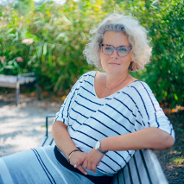
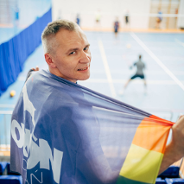
"She's long past her transition, she's managed to save herself": Is this about the protagonist of your book Gdy słońce wypieka sny[1] or about you?

Both, the book is autofiction. I saved myself a long time ago.

How long?

Twenty years. I started thinking seriously about transitioning in the early 2000s. By late 2004, I was ready to go ahead. First, I contacted Prof. Maria Beisert from the Faculty of Psychology at AMU[2], who's now the head of the Polish Sexological Society. She referred me to a free psychotherapy clinic in Warsaw, where I spent two years going through all the necessary steps for transitioning. Less than a year after starting hormones and blockers, the results were already visible - basically, it happened almost instantly. I always had a very feminine appearance. After that, I began the legal process to change my documents, which involved a court case against my parents, as required by Polish law. And then, it was done.

From the way you describe it, it sounds like everything went smoothly and professionally, which of course makes me happy, but a bit surprised.

That's pretty much how it went, and honestly, I was surprised, too. But even though my transition went smoothly, I still had tough conversations with my loved ones and dealt with the usual anxieties. Once I got my parents' green light, though, everything moved quickly. The whole process was done within three years.

What do you mean by the green light from your parents?

I had long, heartfelt discussions with them. I really wanted them to understand my transition and support me. At first, the conversations were very emotional, and it was the first time I ever saw my father get teary-eyed. My mother was terrified, but more about the awful things she feared might happen to her child. As time passed, the emotions faded, and our talks became more practical. Eventually, they said, "Go ahead, we're with you," and they really did support me wholeheartedly.

How old were you when you broke it to them?

About twenty-six, maybe twenty-seven.

Is this considered late?

I recently exchanged emails with an old friend. I'd given her a copy of my book, and after she read it, she told me she loved it but wished she hadn't waited so long to transition, worrying about how it would turn out. Many transgender people feel this way. I told her I transitioned when the time was right for me. The truth is, everyone has their own timing, which depends on both personal readiness and where they are in life. If I were from her generation, my transition might've been seen as early, but from today's perspective, it might seem late.

Late due to circumstances?

I've always known I was transgender, really. Like many people, I tried to deny it, but you can't deny who you are for long. You can't live that way. I finally faced that reality when I was in my early twenties, while I was writing the youth section of my book. I realised I had to either go through with the transition or end my life. I chose the path that started this whole conversation: saving myself. And looking at me now, it was definitely the right choice.

You mentioned you've always known you were transgender. How long have you known?

I've known since I was a few years old, though I didn't know the term "transgender" at the time. But, as I said, I've always had a lot of feminine traits. In fact, until I hit puberty, I could pass for a girl based on how I looked.

Did it cause you any suffering?

Sure, but only occasionally. Honestly, I remember the good moments far better, like at summer camps when I always had an unofficial "boyfriend", someone who secretly admired me, blew me kisses, and held my hand. It felt good, though a bit strange, as I presented as a boy but was treated like a girl. I've felt in between for as long as I can remember.

Are you a native of Poznań?

Yes, I was born here in 1976 and grew up in a block of flats in the Winogrady district. I'd hang out by carpet beater racks or on yard benches, playing French skipping with the girls. My dad was a university professor, a graduate of the Poznań University of Technology, and spent his entire career at the Poznań Institute of Rail Vehicles, now the Modern Mobility Centre. My mum worked in various administrative roles in the public sector. I have an older brother too, but he's gone his own way and we're not in touch. It's nothing to do with me being transgender.

Did you go to Marynka high school?

Yes, I did, and I was always top of my class - a top student all my life. Sometimes I wonder if excelling was a way of masking my difference, a form of compensation. I'm not sure; perhaps I'm overthinking it. Marynka was a great school. It had been shut down by the communist authorities but then reopened after the regime fell. It was a classic school for the children of Poznan's intellectuals. We were involved in arts and theatre, travelled around Poland and abroad - it was brilliant.

Did you know any queer people at the time?

No, but I do remember that when I started at Marynka, before the teachers got to know me, some would address me using the feminine form, assuming I was a girl - which makes sense now, in hindsight. While I could have been upset by it, I actually found it nice. It showed that many people were confused about my gender just from meeting me. I also recall in the second or third year, I was called in to speak with the PE teacher because I kept skipping classes. She told me I should probably be doing PE with the girls, not the boys, because I was so feminine and probably felt uncomfortable with the boys. She saw right through me, Mike!

What did you say?

I was stunned and a bit frightened, but deep down, I took note. More and more people were beginning to see me for who I really was. Even though, when I became an adult, I buried my true self for a while and lived as a man.

Why did you do that?

I didn't think I could cope otherwise.

Couldn't you talk to anyone openly?

No, I couldn't. Everything stayed bottled up inside, which of course led to depression. It remained that way until I was doing my doctoral studies in France. I'd come home from university and start writing, and that's when my book began - it was a form of self-therapy. Getting everything out, putting it on paper, and really looking at myself was incredibly liberating.

Did you have any relationships?

I had a few, both in Poznań and France, but before transitioning, I suppose they could be called gay relationships. I didn't feel comfortable in them because I didn't feel gay, I didn't even feel like a man. It made everything dysfunctional - how could it be anything else? The turning point came when I came out to a boyfriend in France. We're still close friends today. I mention him, Sylwek, in my book. He was the first person I told that I wasn't gay, but a transgender woman. He accepted it, though he asked a million questions. We talked all night.

Did your parents know you weren't straight by that point?

By the end of my studies, they knew I was gay because I had a boyfriend and was head over heels in love with him, so I couldn't hide it. A few years later, I came out again, this time telling them I was a trans woman. Interestingly, my mum took the gay coming out better than my dad, while my dad was more open to the news that I was transgender. At least, that's how I remember it.

You wanted to go to medical school but ended up studying biology. Why?

I wasn't really cut out for dealing with patients and bodily fluids, I preferred something more sterile. That's how I ended up in molecular biology, which I pursued as a researcher. I did a PhD and then a second-degree doctorate. But I've always been drawn to languages as well. I even considered studying English and French philology, but at that time, it was only offered in Warsaw. My parents advised their "good girl" to go for something more "practical" instead.

But you still learned those languages.

Yes, I studied them on the side, took courses, and learned while traveling. I believed that as a transgender woman, I wouldn't be able to live a normal life in Poland and would have to move to the West. Poland in the 1990s was terribly homophobic and transphobic - it repulsed me. Poznań did too, to be honest. I attended the first Equality March, and I remember it well - and the second one too. The aggression, the yelling, the eggs thrown at us. In contrast, I knew Paris, a much more open and queer-friendly city. Back then, the two places were worlds apart, and it took decades for them to draw closer together. But Poznań isn't all of Poland. I don't know how long we'll have to wait for laws that legalise same-sex relationships, ensure fair transitions, and protect women's reproductive rights. It feels like we're light years away.

What was your doctoral thesis about?

I researched olfactory receptors in the tongue's epithelial tissue, as my field is molecular biology - challenging but fascinating. I work at the Institute of Experimental Biology of Adam Mickiewicz University, where I returned after completing my doctoral studies in France. I'm involved in research and teaching, covering subjects like medical virology and cancer genetics. I'm particularly pleased that I'm teaching more classes in English now, which means my passion for languages, as well as my time in France and later in the US, are paying off.

Was it after you returned to Adam Mickiewicz University that you decided to transition?

Yes, it was a very intense time, not only because I had to start the transition process we've already discussed, but also because I had numerous conversations with friends and work acquaintances.

I am curious about how the transition went in the university environment.

I had to inform my superiors, who took note of it without any issues. I explained that I had been diagnosed, that I would be undergoing physical changes, and that my personal details would change as I became Julia. My mum was very firm: it had to be that name and no other. I noticed a few disapproving looks from some of the more conservative people at the university, but those reactions faded in time. As for the students, they were obviously from a different generation, so they weren't bothered at all.

In Poland, when it comes to LGBT+ issues, we tend to expect a lot of drama. But your story - a transgender woman who transitioned twenty years ago and has been living openly and happily in Poznań since - doesn't really fit that stereotype.

There was definitely inner turmoil, but it didn't break me. I was determined to turn my struggles into a plan and follow through with it, regardless of who disapproved. I had no other choice. I only have one life, and I'm happy to live it as a content transgender woman.

I also saw you at the Poznań march for the International Day of Transgender Visibility on 31 March. Trans visibility is growing, and the trans flag is probably one of the most recognisable LGBT+ flags today, alongside the traditional rainbow one. The "T" has finally earned its place in the LGBT+ acronym.

Yes, I see that too, and I think it's a significant step in our movement towards emancipation. It's not that there are suddenly more of us, as some transphobic people believe, or that it's just a trend. We've always been here, but we were invisible, marginalised. In fact, we've had to wait a long time - at least in the Western world - to be seen in public, whereas in many other parts of the world, transgender people have always been visible. Being transgender isn't new, and that's something that can't be said enough. Another thing to remember is that many people today exist across a spectrum of gender identities and psychosexual orientations, rather than fitting into just one label. You can be T, G, and L all at once, in various combinations.

Where do you place yourself on this spectrum?

I identify as a heterosexual trans woman with a touch of non-binary identity. And, you know, I don't think that's particularly sensational in Poznań these days. This city has become very welcoming to our community. I'd even go as far as to say that we've finally caught up with the West mentally, and I hope that other Polish cities will follow suit one day.

[1] The title translates into When the Sun Bakes Dreams.

[2] Adam Mickiewicz University of Poznań

I'm interested in joining Orion. How do I sign up?

The best way is to reach out to us on social media and wait for my response. I'll get back to you as soon as I can, likely with an invitation to your first training session. And just to clarify, Orion is a club for LGBT+ people.

How will you check if I'm LGBT+?

I naturally trust people and take them at their word when they say they are LGBT+. Occasionally, someone who doesn't realise we're a queer club seeks membership only to withdraw after they find out. It seems some folks either don't read carefully or don't fully understand what they read on our website, even though the site is very clear on this point.

Assuming I respond and get accepted, and attend my first training session, who will I play with? Will I be able to cope as a novice volleyball player?

Not to worry, you'll be just fine. Orion values teamwork over individual skill levels, so there's no need to fear others being better players. I assure you that you'll be placed in the right group - we have options for beginners, intermediates, and advanced players. Besides volleyball, we offer badminton, squash, tennis, local cycling, and mountain hiking tours, so there's plenty to choose from.

I haven't exercised in a while and I'm also overweight.

Being overweight isn't an issue. Our club welcomes everyone, regardless of fitness level.

Where do you practice?

It depends on the sport. For volleyball, we rent a gym at a school in the Grunwald district. When we first approached Headmaster Dagmara Bajerlein there, we made it abundantly clear from the start that we are an LGBTQ+ club, to which she replied: "So what?" This may well have been the best possible response.

Why did you choose this particular school?

It has a large gym with three volleyball courts, which suits our needs well. We used to practice in other schools, but they were too crowded. This school was recommended by Bartek Ignaszewski, a city councillor from the Nowoczesna party. For squash, we used to practice at the Galeria Malta shopping centre, which was a great venue. But as you know, Malta is being demolished, and so we've moved to Fabryka Formy near the Arena. We practice badminton there as well and have our tennis sessions at Olimpia. Additionally, as mentioned earlier, we offer mountain hikes organised by our vice-president, Dawid Abramowicz, who has a background in geography and focuses on ecological education. Our cycling tours are usually within a short radius, with Wielkopolska National Park being our favourite destination.

How often do you hold volleyball practices?

We meet twice a week in the evenings for two-hour sessions with a professional trainer, segmented by skill levels.

Where does the name come from? The mythological hero, Orion?

Honestly, I haven't looked into the mythology. The name was suggested by my partner Paweł, who thought that with so many stars on the team, we formed a constellation, hence Orion!

Is Orion exclusively a boys' team?

I would love for Orion to be more inclusive of the entire LGBT+ community, but right now it's mostly made up of cis gay men. However, I want it to be clear and always say that we absolutely do not restrict our membership to cis gay men. Whenever women reach out, I always warmly invite them to join. Recently, two women signed up for our badminton section, and we're expecting more. We've also welcomed our first trans member, so we're gradually becoming more diverse.

The presence of trans people, especially trans women, is highly controversial in sports because, as argued by its opponents, it amounts to discrimination against biological women who are simply weaker than trans women. What is your take on this?

Speaking as a biologist, I can't deny the physical differences between biological men and women. Men generally have a stronger skeletal structure, greater muscle mass and larger size, which makes them simply stronger. The transition does not change things like foot or hand size. These differences impact athletic performance, especially in individual sports. Such are the facts. However, just like Asians excel in volleyball due to their speed and agility despite being shorter than Europeans, queer sports here aim to explore and embrace these differences, making the field more inclusive. At international events like the GayGames and EuroGames competitions, people register in the categories they choose, and it's widely accepted.

How many people train at Orion?

We currently have about a hundred regular members.

How do you pay for the training sessions?

Through member contributions. For instance, everyone chips in fifteen zlotys per session to cover the cost of renting the hall.

Does the city support Orion?

We have significant support from Deputy Mayor Jędrzej Solarski, who oversees sports in the city, and from Bartek Ignaszewski, as well as the city's Sports Department, with whom we have an excellent relationship. We are happy to have the city recognise Orion's potential. Our first funding came during Poznań Tolerance Week, and the city has supported events like the Polish Rainbow Cup. We also received a grant to promote local volleyball, which allowed us to host the Poznań Volleyball Meets last March.

I assume that everyone was welcome.

Absolutely, including straight people. We strive to be inclusive here in Poznań.

Did it matter to anyone that Orion hosted the Poznań Volleyball Meets?

Not at all. We've become an integral part of the local sports scene and have been participating in competitions for a while now. We proudly wear our T-shirts with a rainbow goat and our rainbow flag. Initially, people gave us funny looks because we were a gay team, but that stopped once we started winning. We've never encountered open homophobia in Poznań's volleyball community.

Twenty-two teams from Warsaw, Kraków, Katowice, Wrocław and Gdańsk competed in this year's Polish Rainbow Cup tournament. What do players from these cities say about Poznań?

They think Poznań is fantastic and are quite jealous. I get the impression that people in Poznań assume the rest of the country is just as open and supportive, but that's not always the case. For instance, cities like Kraków, Wrocław, Katowice, and Gdańsk don't always subsidise rainbow games. Poznań is definitely a very open and enjoyable place to live. Even our colleagues from the German league were impressed with Poznań when they visited for a match.

Do you have any sports-related dreams for Poznań?

I dream of having a Rainbow Sports and Recreation Centre here. But more realistically, I share the dream of any athlete in Poznań, which is to see sports infrastructure significantly expanded.

Orion has achieved a lot in a very short time.

We started during the pandemic in 2020, thanks to Dawid Abramowicz and Szymon Szczepaniak. To formalise the group, Paweł and I registered it as an association in July 2021. The registration process was challenging because it risked outing many members, but we managed to pull through. Interestingly, our biggest critic within Orion has since come out, proving that Orion not only keeps you fit but also supports personal growth and emancipation. It makes us all stronger.

And it challenges the stereotype of timid gay people.

Exactly. Orion was created to break this stereotype and to let us enjoy sports without the toxic hetero-macho culture that often deters LGBT+ people.

Do sports media cover Orion?

They do, and increasingly so. At first, they covered us as a curiosity. Last year, Fakty TVN did a story on us, and this year, Poznań's TVP3 covered the Polish Rainbow Cup, which is a step forward. Sports in general are slowly opening up to the queer community, as seen by more professional athletes coming out, like kayaker Katarzyna Zillmann and volleyball player Katarzyna Skorupa.

Have you got any sponsors?

Currently, we rely on smaller companies that support rainbow initiatives. We hope to attract a major sponsor eventually.

Why is there no youth section in Orion?

Setting up a youth section involves a lot of formalities and a different level of responsibility, which we aren't ready to handle just yet. Hopefully, that will change someday. For now, most of our players are between twenty-five and forty years old.

I don't fit into this age bracket anymore.

Don't worry, neither do I.

And where do you, the club's president, stem from?

I'm from Karsko near Gorzów Wielkopolski, where I was born in 1981 and raised. It was a typical communist-era collective farm, so I grew up surrounded by animals and nature. My dad worked as a turner on the farm, and my mom was employed at the post office. Karsko's beautiful location amidst lakes and forests made my childhood idyllic.

After political transition drove state farms to collapse, was it still as idyllic?

Being a child, I wasn't much affected by the changes. My mum started running a news kiosk, and my dad, with his marketable skillset, found a job in a private company. My parents worked hard to ensure my siblings and I didn't go without, although we didn't have an abundance of anything. Today, my mum is a municipal councillor and president of the Rural Women's Association, while I am president of Orion. So, you could say I followed in her footsteps - we're both presidents.

A collective farm near Gorzów doesn't seem like a queer-friendly place to me.

You might be surprised. In the late 1980s, we had a trans man in Karsko, the brother of my primary school mate. Everyone knew about him, and while people pointed fingers, his mother was a respected nurse, which likely protected him from extreme violence, though his life must have been hell nonetheless. There was also a lesbian neighbour who visited occasionally with her daughter, and everyone knew about her. One of my two best friends was also lesbian. So, our collective farm community came in all colours of the rainbow. This exposure made LGBT+ issues familiar to me, showing me that it wasn't just Steven from "Dynasty".

When did you first think you could be like Steven?

It was during high school in Gorzów, where I commuted daily from Karsko by bus. Like many, I fell for my best friend. And, as you might remember, since we're age mates, our sex education came mostly from Bravo magazine. I had a girlfriend for a while and then got into church and religion, which was pretty typical for a gay teenager exploring his identity in the 1990s. I actually started coming out in college in Poznań. I vividly remember my first date with a boy at Rondo Kaponiera when I was living in the Jowita dorm. When he greeted me with a hug, I knew exactly who I was.

Did you share this with anyone?

I joke that my parents found out I was gay through osmosis. They simply got used to my partner being around. Paweł, my namesake, and I met in college, and he often tagged along with me to Karsko. My sister later told me that after one visit, my dad said: "Paweł's Paweł must be his girlfriend". Our LGBT+ vocabulary was quite limited back then. My parents accepted us, though interestingly, my mum took longer to come around than my dad. Our relationship with Paweł's parents is just as good, so I don't have any sob stories to tell.

Before you realised you were gay, did you want to be a biologist?

Yes, I'd wanted to be a biology teacher since primary school. I majored in biology at Adam Mickiewicz University and briefly considered forestry at the University of Life Sciences. I was also into foreign languages, which led me to study English philology later. After graduating in biology, with Ewa Zgrabczyńska, the famous director of the Poznań Zoo, as my thesis supervisor, I entered a doctoral programme but eventually dropped out realising it wasn't my true interest. I tutored biology one-on-one for many years as the pay and other conditions were much better than in schools.

Did you and Paweł start dating during your studies?

We didn't really hook up until the end of university. Paweł pursued me persistently despite my initial reluctance. I was more interested in enjoying my youth and living life to the fullest in a vibrant city. But eventually I caved, and we've been together for almost twenty years now. After finishing his biology degree, Paweł went on to study journalism and then worked in the field. He became a journalist, a publisher at TVP in Poznań, and a City Hall spokesman. He currently works at the Ministry of Climate and Environment.

What's the secret to a lasting gay relationship?

A lasting relationship is built on love, friendship, partnership, understanding, and a shared purpose. Paweł is also involved in Orion, which helps. Honestly, I can't imagine life without him. And it isn't because, as the saying goes, nothing bonds people like a shared mortgage loan.

Not only are you gay, but also a hairdresser - it seems you're living up to a common stereotype.

What can I say? I've just got to roll with it. But honestly, there are plenty of straight hairdressers, even though this line of work has long been considered a women's domain. Even back when the most famous hairdressers were men, such as Vidal Sassoon or Antoine de Paris. When I decided to become a hairdresser in the early 1990s, half my family laughed at me, and so did almost everyone at the vocational school I attended.

Was choosing hairdressing at a vocational school a form of coming out?

For some people, probably yes, though it was something you only whispered about back then. We weren't free to discuss it openly - neither at my school nor the two others where I apprenticed, first for four weeks at one, and then six weeks at another. The former was in Zgorzelec, where I was the only boy, the latter in Świebodzice near Wałbrzych, where six of us learned hairdressing alongside a bunch of carpenters, so you can imagine how much fun that was.

Did the carpenters get along with you?

They did, despite the usual fag jokes.

Before we go any further, I want to ask you about the term "barber", which is increasingly being replaced by "hairdresser" or "hair stylist". Do you identify as a barber or a hairdresser, and does it even matter?

It doesn't matter to me - you can call me either of these two. Recently, the term "czeladnik fryzjerstwa" ("hairdressing journeyman") has been making a comeback. I actually have that title on my certificate. Nowadays, when you first start out, you're called a barber, but once you reach a high level, you graduate to stylist or hairdresser. But that's not a hard-and-fast rule. There are plenty of self-proclaimed stylists on TikTok whose skills are clearly lacking.

How old were you when you set your sights on becoming a hairdresser?

Thirteen, I think, I was in the seventh grade of primary school when I started thinking about what to do next. I didn't want to go to high school and then college because academic studies wasn't my thing. I wanted a specific trade, so I chose a vocational school, and I've never had any regrets or felt ashamed of it, even though I know vocational schools don't have the best reputation.

Where were you living at the time?

In Zielona Góra, where I was born and raised. I had a great childhood, wonderful parents, and a brother who's seven years younger than me. My dad worked in the police, and my mom was a waitress and bartender in the best pubs, and later also a cafeteria manager. Thanks to that, during the communist era, we were always stocked up on meat, coffee, and other goodies. Plus, our neighbour was a Pewex[1] manager, so we were pretty well-off! My brother, who's an excellent bartender, followed in my mom's footsteps - he teaches bartending, judges international competitions, and runs his own cocktail bar in Zielona Góra with his partner. As you can see, our family values ​​skilled trades.

When did you first realise you weren't straight?

We'd have to go back to that vocational course with the carpenters. At the time, I had a girlfriend, Kasia, who was also in training to be a hairdresser. Kasia was quite the character - tanned, lots of jewellery, an amazing hairstyle, and always perfectly styled. She caught the eye of one of the carpenters, who started hitting on her. The plot twist? I developed a crush on him. It was there and then that, you could say, I realised I was gay.

What a great story.

It still makes me laugh.

Hairdressing is a hands-on profession. Where did you get your training aside from the vocational schools?

I apprenticed with Mrs. Maria Stołpiak in Zielona Góra. She ran a small hair salon and was the one who really taught me the trade. I worked with her several times a week for three years, starting with the simplest tasks, of course. Then one day, she said, "Darek, the next client that shows up is all yours - you're going to wash her hair." And guess who walked in? My mom, wanting to see how I was doing. Well, I did my best, but I ended up soaking her back when I washed her hair.

I bet the first haircut was even more nerve-wracking.

Absolutely. Once you cut someone's hair, there's no turning back. My first client was my brother, and we ended up having to go to another barber to have his head shaved down to a six-millimetre buzz cut. Even after the shave, you could see uneven spots here and there.

Learning through mistakes is the way to go.

Exactly. One time, Maria gave me a special hair lightening powder used for foil highlights. She told me to practice on my aunts, and I did until I ran out of the powder, which is when I bought a Polish substitute. I used it to do highlights on my neighbour's friend, and she suddenly complained the foil burnt her. I touched it and it was indeed hot - her hair underneath was completely fried and fell off as I unwrapped the foil. Maria laughed, just like you are now: "Darek, you must never use that powder with aluminium foil!" That's how I learned the trade.

How many such casualties did you have?

I lost count, but it was definitely worth it.

What was the next step in your hairdressing career?

A large chain, Gabriel beauty parlours, was moving into Poland and hiring young hairdressers. I applied, passed the practical exam, and got accepted into an eight-week course taught by top Italian hairdressers. It was an amazing experience that opened my eyes to what hairdressing could really be. That's when I first got exposed to the world of celebrities, fashion shows, and photo shoots. Then, in the mid-1990s, I decided to move to Poznań, which I was already familiar with from childhood visits.

Was it a happy transition into adulthood?

Not exactly. On my way to the Gabriel parlour for the exam, I had an epileptic seizure on a city bus, which led to a diagnosis of epilepsy. I was put on a medication, but it left me feeling groggy all the time. And so after two years, I discontinued it. Eventually, I had another seizure and, long story short, I was diagnosed with a glioma in my left hemisphere. It seemed there wasn't much to do except wait for the inevitable but then Maciej Krajewski from the Łazęga Poznańska Association, who works as an oncology nurse, recommended a specialist in Bydgoszcz. I went there with my brother, who turned out also to have a glioma. He underwent surgery first, after which I had two operations. Thankfully, we're both still alive today, though our annual check-ups are always nerve-wracking. Since the diagnosis, I've decided to live life to the fullest, making the most of every moment.

And live in Poznań. Have you ever considered moving to Warsaw at the start of your career?

Yes, the idea did cross my mind more than once. In the early 2000s, Jaga Hupało, who I was already working with at a Poznań hair salon, offered to hire me and Piotr Bocian at her soon-to-be-opened parlour in Warsaw. But things dragged on, and in the meantime, Piotr and I started thinking about setting up our own business. The funny thing is that the two of us didn't get along at first and competed for the same clients. But eventually, we became friends and then business partners, owing to our mutual desire for self-growth. In 2000, we opened our Hair Bazaar Studio.

Where did the name come from? Poznań already has a Bazar that plays a vital role in the city's history.

Our Bazaar, spelled with two "a"'s, was inspired by Harper's Bazaar magazine. But you're right, it also ties nicely with the historic hotel in the centre of Poznań.

You opened the studio on ul. Krysiewicza, which wasn't exactly a popular neighbourhood back then.

We chose that location because we found a 300-square-meter, two-story space that was perfect for our purposes, even though it was in a part of ​​Poznań that people generally steered clear of at that time. But that didn't deter us, and the area started to improve quite quickly, thanks in part to Grażyna Kulczyk, who was already a client of mine back then. She used to come in every day at ten to seven for a wash and a style. One day, she showed up with her daughter and said, "Darek, we're neighbours now. I bought the park next door and we're starting the renovation of the Old Brewery." The brewery, which completely transformed this part of the city, is now an iconic building.

Did many people think you and Piotr were a couple?

Of course, but we were never romantically involved - we were just friends and business partners. Piotr actually came out very quickly. He was probably around fourteen when he told everyone he was gay, and he's always lived openly.

And you?

I struggled with it for a while, mainly because I feared rejection, especially from my loved ones. That's why my coming out happened later, when I was already an adult and earned my own living. My parents actually found out when Piotr, his partner Krzysztof, and I were going to a grape harvest job together. It wasn't hard to figure out. But there was no rejection from my relatives; my parents know my gay friends and have no problem with them. The same goes for my brother. I told him I was gay when I got drunk after breaking up with my boyfriend. He asked, "Why are you being so weird today?" I replied, "Because my boyfriend has left me!" We had a drink together, and that was my coming out. I was about twenty-four at the time.

It sounds like you were pretty busy during that time.

Yes, Piotr and I always worked a lot, sometimes ten to twelve hours a day. It's still the same today, as it should be. And I'm not complaining - I'm happy to be busy, and we always have lots of business. We're usually fully booked for the next two months.

Hard work alone doesn't fully explain your success - there are plenty of other hardworking hairdressers in Poznań who are much less successful. What's the secret of your Hair Bazaar Studio?

I think it's our openness and vibrant social life. We've always held lots of events, fashion shows, and parties, wanting our place to be more than just a hair salon. We've also trained many people in the trade, and a lot of them now run their own salons in Poznań. Of course, it's hard to see someone leave after you've invested in them, but that's just the way it goes. At first, I didn't handle it well - I blame myself for someone's leaving. But then I realised that this is how our profession works. After all, I left my previous jobs too. The manner in which someone leaves is important, though - there's a classy way to do it and a not-so-classy one, and we've seen both. But we also have people who have been with us for many years.

Did it matter that the salon was founded and run by two gay men?

I think it had a big impact, especially in the beginning. Twenty-five years ago, being gay was still a bit exotic. For some people, going to a gay hairdresser was a way to show their openness; for others, it was socially appealing. And some women believed that gay men could better bring out their beauty because we see them differently.

Did you experience homophobia in Poznań?

Apart from the occasional insult, nothing terrible ever happened to me. I actually have lots of funny stories to tell. For example, a woman once brought her son for a haircut - this was before we had our salon - and said, "You know, we used to go to this guy named Tomek, but he's gay, so we had to stop going." I just smiled, gave her son a haircut, and when she was paying, I said, "You know what? You won't be able to bring your son here anymore because I'm also gay." Piotr, his client and me had a good laugh about this, and the woman never came back.

Is Poznań a different city today?

Absolutely, a far cry from what it used to be. When I first moved to Poznań, I attended a gay party that I distinctly remember being held in a milk bar in Grunwald. Imagine that - a gay party in a milk bar[2]!  Like in Marriageable Girls[3]! That's where I met Tomek Nikita, the same Tomek that the homophobic lady and her son stopped going to. I also remember Grobla, a pretty rough neighbourhood at the time, having an underground gay pub - a small, sketchy place in a basement with a toilet behind a curtain. We've come a long way from those dingy basements to having a gay pub in the Castle.

When did you start going to equality marches?

Not until later, actually - only when the Stonewall Group began organising them. I didn't feel the need before, but now I have a lot of fun at the marches. And I'm not alone. More and more people from across Poland come to Poznań for the Equality March, and I often hear that Poznań is the most queer-friendly city in the country.

Have you ever wanted to leave Poznań?

There was a time when we considered it. Piotr and I thought about opening a second salon in Warsaw. The plan was that I'd run the one in Warsaw and Piotr would stay in Poznań. But we eventually decided against it. I visit Warsaw quite often. When I had a boyfriend there, I would go almost every week. But Poznań has won out in the end, and I'm very happy with that decision.

What's trending in the hairstyling world these days?

There are lots of trends, and many of them keep returning. For example, hairstyles from the 1990s and 2000s are making a comeback. The days when half the country would wear the same hairstyle that happened to be in fashion are long gone.

Do you always grant clients their wishes?

Their requests are my inspiration. Generally, I'm open to clients' ideas, but if I think something isn't right, I won't do it, I have to decline. Some people take offense in that, others go elsewhere to get what they wanted, often with disastrous results. But those instances are rare. About half of my clients have been coming to me for years, even if they've moved to other cities.

Does this mean Hair Bazaar Studio doesn't need to advertise?

There's no better advertisement than word of mouth, a referral from a satisfied customer. Plus, after so many years, we've established ourselves as a strong brand in Poznań.

For the past three years, the studio has been on ul. Święty Marcin, and no longer on ul. Krysiewicza. Why the move?

The old location, where we spent over twenty years, needed a major renovation, but the building's owner wouldn't approve it. So, we decided to find a new one. Surprisingly, the move wasn't difficult, which made me realise it was the right decision. Recently I visited our old spot on ul. Krysiewicza because a friend of mine opened a restaurant there after moving her La Bottega from Św. Wojciech. It was funny to sit at a table where my workstation used to be after all those years.

In December 2023, Piotr Bocian passed away unexpectedly. You're now singlehandedly running the business you both created and managed together for years.

His death hit me hard. For about two months, I had no idea what to do next or how to carry on without the person I'd been friends and run a business with for close to three decades. But eventually, I had to move on because life doesn't stop, and I had to find a way to manage things on my own. I think everything is going well now and is going to stay that way. I'm work even longer hours now, but I still enjoy what I do, which in itself feels like quite an achievement after all these years.

[1] A chain of shops in communist Poland that offered Western goods unavailable in regular Polish shops. The goods were available exclusively for Western currencies

[2] Milk bars were cafeteria-style establishments in communist Poland subsidised by the government to provide affordable, nutritious meals to the public. They were known for their no-frills, utilitarian atmosphere and were a staple of daily life for many people, especially those who couldn't afford more expensive restaurants. 

[3] A 1972 Polish film directed by Janusz Kondratiuk. This light-hearted comedy follows the story of three young small-town women who spend a weekend in Warsaw, hoping to meet eligible bachelors and experience the excitement of the big city.

What is your recollection of the "good change" [1] era?

That time was hard, yet oddly exhilarating, as it coincided with my coming of age. I felt as though I was constantly being drawn into political debates. During that period, I moved from Toruń to Poznań, enrolled in an art history programme at university, and began living life on my own terms. That mattered because I come from a very conservative family. In Poznań, I finally felt free, met brilliant people, engaged with the drag scene with friends, and started doing exactly what I wanted.

So was it a mix of highs and lows?

It was, because I was constantly compelled to protest for various causes, standing up for our rights, whether women's rights or LGBT+ rights.

Why did you choose to study in Poznań? You could have stayed in Toruń and studied art history there.

Toruń specialises in early art, with a particularly strong archaeology department at Toruń's Nicolaus Copernicus University. Since I was more drawn to contemporary art, especially Central and Eastern European, Poznań appeared to be the better choice. And also, my sister was already studying there, so I was familiar with the city, and Poznań simply struck me as a fantastic place. I moved there in 2016.

The art history department in Poznań is known for its stark divide between progressives and hard-line conservatives. Did you sense that tension?

By the time I finished my studies, I certainly did. That was actually one of the reasons I decided not to pursue a master's degree there. After completing my bachelor's, I switched to curatorial studies at the Poznań University of Fine Arts, where I graduated with distinction. While there, I immersed myself in queer art. I wrote my master's thesis on the subject, supervised by Marta Smolińska, although I had started the research earlier at the Institute of Art History at Adam Mickiewicz University under Paweł Leszkowicz. My focus was on the Warsaw festival Pomada. I felt the need to be closer to artists, to work with them, and to express myself as a curator.

What drew you specifically to queer art?

At first, I was also fascinated by medieval art, but ultimately contemporary art, and especially its feminist and queer aspects, won me over. Art history majors are actually required to write two bachelor's theses and then choose which one to defend. I wrote one on the negative portrayal of Jews in Polish Gothic art, and the other on the overlooked contributions of women to the works of artists from Bosnia and Herzegovina. Unsurprisingly, I chose to defend the latter, under the supervision of Magdalena Radomska. From that point forward, I steadily moved in the queer direction. Even before I started my studies at the University of Fine Arts, Gosia Mycek invited me to curate my first queer exhibition. It was staged as part of a benefit for a friend's gender transition and titled Against the Family. The exhibition explored the notion that we, queer people, want, can, and often have to build new chosen families. That was the time queer truly exploded into my life.

What does queer art mean to you?

As you know, defining queer art can be tricky. It's more appropriate to speak of definitions in the plural. Personally, I subscribe to the understanding put forward by Eve Kosofsky Sedgwick in her book Epistemology of the Closet,  which, unfortunately, has never been translated into Polish. She describes queer as any breach of heteronormativity. That is how I prefer to see it: a breach that does not necessarily have to be affirming, because queer is not always fun and flamboyant - something many tend to forget.

Which brings me to the Arsenał Municipal Gallery, where in June, during Pride Month, you co-curated the exhibitionLGBT+ Zones: Queer Art in the Time of the "Good Change".

I did that indeed, with Tomek Pawłowski-Jarmołajew. We knew each other beforehand but had never collaborated. Once we got started, it quickly became clear we both had our sights set on creating a queer exhibition. At first, we dreamt of a large-scale cross-cutting show, but we needed a reality check to make sure our project would fit the space available at the Arsenał.

Poland's largest queer exhibition to date remains Ars Homo Erotica, held in 2010 at the National Museum of Warsaw during Piotr Piotrowski's brief directorship, and curated by Paweł Leszkowicz. Both were academics at the Institute of Art History at Adam Mickiewicz University.

That exhibition is a benchmark. Queer displays in Poland are generally seen as those either preceding or following Ars Homo Erotica. Sadly, I was too young to attend it myself.

I did go - I even interviewed Paweł about it. That show, very much a gay exhibition at its core, was clearly a product of its time. Today, however, we speak of queer exhibitions, which is one of the developments since then. The other is the presence of many queer artists from Belarus and Ukraine now living in Poland, which had significantly altered the landscape.

Yes, and that's something Tomek and I found especially compelling when organising the show. It's no coincidence we offered guided tours in Ukrainian and Belarusian. And you're absolutely right: meeting artists from the East really shifts perspectives, because even during the "good change" years, LGBT+ people in Poland were better off than queer people in Belarus. It is worth noting that Belarusian art in Poland is thriving wonderfully, also beyond the queer scene.

Did working on this exhibition teach you anything?

Definitely - I learnt much more about queer performance, especially thanks to Andrzej Pakuła, who curated our performance programme at the Pavilion. And you know what surprised me? Not a single protest against the exhibition.

That's what Mikita Ilynchyk told me after the premiere of hisPygmalionat the Polski Theatre. I told him then what I'll say to you now: Poznań is long past the point of "offence to religious sentiments", as it is often referred to. While Poland grows increasingly right-wing, Poznań appears to be moving in the opposite direction.

Exactly. I was used to the Toruń climate, where anything could be protested - from Behemoth concerts to Marina Abramović exhibitions.

Do you identify with any of the letters in our rainbow acronym?

Mostly with the letter L, although I have always had relationships with men, too. The thing about those letters is that they can feel more limiting than defining. If I had to label myself, I'd say I'm bisexual and homoerotic, because I've never been able to form a romantic relationship with a man. I just don't have the heart for it. With my girlfriend, whom I recently got engaged to, we live openly as lesbians. Our friends always say they're going to see "the lesbians" or "lezzies".

Was it the same in Toruń?

As I mentioned, I come from a highly conservative, religiously devout, right-wing family. Yet both my sister and are lesbians. So it is no surprise at all that our relationships with our parents are complicated. I can't bring my girlfriend home, and since that's not possible, I simply don't visit. To make matters more difficult, my girlfriend is trans, which is more than my parents can accept. My sister, from time to time, could invite her girlfriend to family gatherings under the pretence of being a "friend", but I can't, because the way my parents see it, that looks far too queer.

When did your queer life begin?

Back in high school, when I identified as bisexual. I had a lot of good friends but still encountered biphobia, the classic line being "fine, whatever, but you'd better make up your mind". It's funny that when a guy says he's bi, people assume he's gay, but when a woman says it, they assume she's straight. My theory is that people simply can't allow themselves to accept that a relationship with a woman can actually be fulfilling. There's still an ingrained belief that a man must be at the centre of attention.

Were there any queer clubs in Toruń at the time?

Just one. For a long time, there wasn't even a Pride parade. Toruń only started shifting in that direction after I'd already left. These days, there are queer spots there, such as Równik, and several queer-friendly venues. I still visit now and then, and I've even joined their Pride parade with my girlfriend. It was brilliant, though of course nowhere near the scale of what you see in Poznań.

Did you bump into any former school mates at the Toruń Pride parade?

No, I didn't, although there was a lesbian classmate in high school, and everyone got on with her perfectly, including me. It all seemed fine until the prom, when some of the girl's male classmates refused to share a table with a lesbian. This sparked a major scandal. It was rightly called out as straight-up discrimination. I remember my Polish teacher stepping in firmly, which was brilliant. The school I attended, III LO, was already among the most LGBT+ friendly places around at the time. Honestly, I quite enjoyed living in Toruń, though eventually it felt too small for me. I really appreciated the local Contemporary Art Centre, something Poznań still lacks. The first major queer exhibition I attended was one of Karol Radziszewski's works at that very Centre. Who knows, I may return to Toruń to retire.

Did you come out before leaving for Poznań?

I did, although at first my parents probably thought I was doing it just to spite them - we used to tease one another at home. And since I dated both boys and girls, they assumed I'd eventually settle with a man. To appears I let them down again, and as I've mentioned, that chilled our relationship. The same ritual plays out every year: my mum asks if I'm coming home for Christmas, I ask if I can bring Ida, mum says no, so I don't go. I find it very important to draw that line. If you don't accept who I am, there is no way we can share a meal. That would feel like pure hypocrisy. Why pretend?

You moved to Poznań just as its queer scene was beginning to flourish. Did you feel you were part of that change?

Even before moving, I was aware that Poznań was becoming increasingly more queer. That lesbian friend I mentioned had already filled me in on that. And through my sister, I quickly found myself immersed in a queer circle - we dived headfirst into drag, putting on all sorts of wild performances. I loved every minute of it, though I never had much of a stage presence, which perhaps explains why I ended up studying art history and theory rather than creating art myself. I've always been more drawn to engaging with other people's work.

For a long time, queer bars tended to be predominantly gay, as lesbian spots often closed down faster than they could open. Today, most queer places welcome everyone. Do you visit them?

I've only ever heard rumours about lesbian bars. As for queer hangouts, I do go there, although I'm not much of a clubber and definitely not into the drinking culture. I'd much rather attend exhibitions, performances, art events, or house parties. In fact, it was at one such party that I met Ida, my girlfriend. We'd already been following each other on Instagram, dropping subtle hints, liking each other's posts - then at that party, we just clicked and haven't looked back. We've been together three years now. Interestingly, Ida is binary, which in quite unusual in my closest drag circle, the House of Orzeczenie.

Do you live together?

Yes. At first, we lived in a drag commune, but these days it's just the two of us, in the Jeżyce district naturally. Ida is an English philologist who specialises in computational linguistics and is well versed in the various feminist cyber themes that are currently all the rage in the art world. I've already got her to help me with a couple of exhibitions. We love creating things together, and we're very happy. Life in Poznań suits us perfectly.

[1] Translator's note: "Good change" ("dobra zmiana in Polish") was a slogan and rallying cry of the Law and Justice party promising to bring fair, responsible, and citizen-focused governance. Critics claimed it was a power grab cloaked in shiny rhetoric that resulted in democratic backsliding.

In drag, you go by the name Atra de Vil (Atra being short for attractive), which is fitting when one sees you. However, as a DJ, you perform under the stage name Unattractive. Why is that?

Because I feel unattractive, not physically, but mentally. I used to believe my personality was entirely unappealing, like there was something wrong with me. Now I've worked through those feelings and turned what I once saw as weaknesses into strengths. So, I'm planning to retire Unattractive soon and rebrand as DJ Hazziak, with a double "z" to set it apart from my real surname. 

Why don't we unpack your feelings of being unattractive.

I come from a small village with the off-putting name Słupy Duże in the Kuyavian-Pomeranian Region, where I always stood out like a sore thumb. You might say I was different. Instead of playing football with the boys, I played acoustic guitar, hung out with girls, and had an artistic soul. I expressed myself at school assemblies, singing patriotic songs and carols. Day-to-day, I faced constant bullying and hurtful names, like "hermaphrodite" and "tomboy".

When did all of this happen?

I was born in 1999, so I grew up in the twenty-first century. I lived in a multi-generational home, with my parents and sister on the ground floor, and my grandparents and uncle upstairs. My grandparents were farmers, while my parents pursued different careers: my mother worked for a grocery wholesaler, and my father was a truck driver. If it weren't for homophobia, my childhood would have been idyllic - the village and its surroundings were one big playground.

Were your parents aware of your struggles?

They were. Whenever something bothered me, I talked to my mum about it. She usually sensed when something was wrong and asked if I was alright. I shared some things with her but not everything, believing I should handle them myself.

Did you cope?

It was tough, but it definitely made me stronger. Nowadays, when I hear a homophobic remark, I just brush it off.

Was there a school in Słupy Duże?

No, there wasn't. I went to school in Bądków, two kilometres away in the same commune. Then I attended high school in Inowrocław, where things were much better and, most importantly, where I met other queer people. Before that, I felt like I was "the only gay person in the village". In Inowrocław, I had my first romantic relationships, flings, and heartbreaks. I still heard homophobic remarks from boys, but not as frequently as in the village.

Did you struggle with insecurities about your rural background?

Never, probably because I'm quick to connect with people and fit in. Besides, why should I be ashamed of my rural origins?

You were in high school in the 2010s. By then, many gay dating websites were already available. Did you use them?

Back then, I mainly used fellow.pl, but I also met guys through word of mouth, which worked well. My two lesbian friends were on it too. We all managed fine. And when social media came into play, things changed dramatically, especially for someone not living in a big city. It's hard to meet someone when the nearest gay person on Grindr is twenty kilometres away.

Where did you live in Inowrocław?

At a boarding school because I wanted to be independent as soon as possible. There were a few other queer people living there too, but both of my roommates were straight. One very cerebral and a true metalhead with long hair, the other, a bespectacled chess player and a buff of all things military. And then there was me, a gay fan of Ariana Grande. However, we got along great, and our room became the social centre of the boarding school. A lot went on in it.

Did your roommates know you were queer?

They probably guessed it. In fact, I have to say that if someone in high school asked me directly if I was gay, I would say yes. I didn't want to live the way I did in the village anymore. I was tired of hiding and lying. I wanted to be true to myself.

You figured that out pretty early - well done.

I think my upbringing played a big part, especially what my mum and dad taught me. Mum, in particular, always told me to help others because kindness comes back around. Everyone who meets her says she's the most positive, cheerful person they've ever met.

When did your mum find out you were queer?

I had a girlfriend in high school when I thought I was bisexual. When we broke up, my mum wanted to know what happened. I didn't want to talk about it, so I closed myself in my room and cried. Mum came in and asked what was wrong. That's when I told her I thought I was bi.

How did she react?

She told me to take time to calm down and think things through. She also suggested talking to a psychologist because adolescence is always tough. She asked if she could tell dad. He found out the next day and surprisingly reacted better than mum. He came to me and said I'd always be his son and that he'd always love me.

Did it take your parents long to adjust?

It took a few months, maybe a year. Our relationship obviously faded; they needed time to wrap their brains around it. Today, they're as supportive as can be. They both came to New Year's Eve at Lokum last year, and mum even attended her first Poznań Pride and Equality March this year!

Did she then see you in drag for the first time?

No, she had already seen me in drag once before. She then said, "Well, you look nice, but those shoes need cleaning!" Nowadays, my whole family knows I'm queer. When I came out to my sister, I dreaded her reaction, but she said, "Well, so what?" It didn't bother her at all. My aunt, who is my mother's sister, was a bit upset, but mostly because she hadn't been told earlier and found out from my grandmother. Grandma, on the other hand, shouts at the TV to leave these LGBT+ people alone! As you can see, my family is a riot.

So the coming out was quick and comprehensive?

It was. When I moved to Poznań, I put an end to my doubts and ambiguities with a Facebook post. The response was overwhelmingly positive. Even my uncle, who used to make homophobic jokes, wrote he was proud of me. My mum jokes that I may not be lucky in love, but I'm lucky to have such a supportive family.

Unlucky in love, huh?

Yeah, and I think it ties back to what started this conversation - what's in my head, my self-esteem. Being locked in toilets with schoolmates banging on the door and calling me names like "hermaphrodite" definitely took its toll. These experiences, along with others, triggered bouts of depression in me. They may have also led me into misguided relationships. Now I'm single, focusing all my energy on achieving the goals I've set for myself, centred on drag and music.

And this brings us to Poznań.

Yes, when I arrived in Poznań in 2018, it was to study - wait for it - forensic chemistry at Adam Mickiewicz University. However, after three gruelling semesters, I dropped out realising it wasn't the right fit for me. Despite this, I fell in love with the city, even though I hadn't explored it much before. My only previous visit had been during a school trip, where my Spanish teacher took us to places like the Palm House, Muza cinema to see the beautiful film "Ma Ma" starring Penélope Cruz, and the Mexican restaurant Czerwone Sombrero. I enjoyed Poznań then, although to be honest, it was my backup plan. Wrocław was my first choice, but I never settled down there. Eventually, I completed a marketing and business management programme at WSB University (now WSB Merito University), as a fallback, fulfilling my mum's wish for me to have a degree and a diploma in hand, something she never achieved herself due to having me early in her life. Now my sister and I are encouraging her to pursue her own college dreams.

How did you get involved in Poznań's queer scene?

I dove into the HaH dance floor, HaH being the first queer club I'd ever been to. I soon became a regular, visiting it up to four times a week. There was always something happening! When Lokum opened on ul. Półwiejska, our bunch started going there too. We loved it, and I found myself there more often, meeting new people, and eventually landing a job. It happened somewhat spontaneously. I already had a good job at an Adidas outlet in Posnania, but when Duże Lokum opened and I decided to support their crew. Then one thing led to another, I started with bartending, and eventually became their DJ. I juggled both jobs for a while, sometimes working up to 250 hours a month. Initially, my parents weren't thrilled, thinking it distracted me from my studies, but I valued my independence. Once they saw I could handle it all quite well, they eased up.

Was it at Duże Lokum that both Atra and Unattractive were born?

That's right. This was where I started meeting more drag queens and learning about drag culture. The first drag queen I saw, which I think happened at HaH, was Lelita Petit. Later in Lokum, I encountered others, like Ann Fetamine and Bom Belle, both of whom hosted bingo. They introduced me to drag, and when I stepped on stage as Atra de Vil, I was a sensation. I instantly knew it was what I wanted to do, partly because I loved being on stage and had always dreamed of being a star, but also because drag queens get away with a whole lot more than others. Atra was Haziak on steroids.

Is your career going well?

Absolutely. During this year's Poznań Pride, I finally put together a show specially for the occasion, complete with stage design and dancers. Overall, drag is an expensive hobby - cosmetics, costumes, shoes, and wigs all cost an arm and a leg.

Do you buy it all or make some of these things yourself?

In the beginning, many of my outfits came from thrift shops. I pieced them together from ready-made items, giving them a new lease of life. These days, I increasingly order clothes, including from designers. My ensemble for this year's Poznań Pride was from the Patryń Atelier. Of course, shoes need to be customised too, you won't find size forty-two heels in a regular shop. The same goes for wigs, which then need styling - I haven't mastered that yet, so I get help from Bom Belle. Makeup is all about practice, and I can handle it myself now.

What do you enjoy the most about drag?

The people. I love interacting with others, chatting, joking around, and meeting new faces. I never refuse a photo request, and I always keep a positive attitude, thanks to my mum's guidance on being a good drag queen. It's fulfilling to blend drag with music, and I'm thrilled about what lies ahead. I'm happy to have finally found myself in Poznań.

What letter are you in the rainbow acronym LGBT+?

I'm two of them, T and G, although I think I prefer to just identify as queer because it's a broader term.

Since when have you been using that label?

I realised I wasn't straight well before it came to me that I wasn't cisgender, though it's not a long story - I'm only twenty-two. Overall, I figured a lot of things out later in life because I had other issues to deal with first.

Such as?

The biggest challenge was to sort out my feelings after my mum passed away. She died when I was fourteen, a young adolescent. Her departure hit me at the worst possible time and consumed my thoughts.

Where did it all play out?

I grew up in Baranowo, on the outskirts of Poznań, in a very diverse community. Long-time rural residents lived there alongside newcomers who bought suburban homes. One of my classmates, for instance, was the daughter of Piotr Reiss, the famous footballer. It was quite a mix of people.

Any LGBTQ+ people in this suburban mix?

In middle school, a girl came out as a lesbian, which sparked all kinds of rumours about her, many of them hurtful. My friends and I decided to explore our own identities together. One of these friends, who is also transgender, and I are still in touch. They were my main support during that time, especially after I could no longer turn to my mum.

Could you rely on your dad?

I used to find it hard to talk to him, especially about these things. My mum's passing brought us closer, but it took us years to get there. Meanwhile, in middle school, I realised I was queer, that I didn't fit into the clothes or labels assigned to me. This was way before my transition, so people saw me as a lesbian, but that wasn't me. I felt like an actor playing roles scripted by someone else. In middle school, these roles were first of a girl and then of a lesbian.

When did you feel you had to start writing your own script?

Towards the end of middle school. That's when I participated in my first Equality Parade in Poznań. It was intimidating, yet fascinating. I painted my face in multiple colours, made a banner from a bedsheet, and took a public bus from Baranowo. It marked a bold step forward, coinciding with the start of high school at St. Mary Magdalene Secondary School in Poznań.

In the book "A Different City", I interviewed Piotr Mazurkiewicz, a biology teacher there. Did you have him as a teacher?

No, I was in a humanities class, but I remember him from the time we checked out the entire staff at the beginning of school. His shirts stood out, and we had a feeling he might be queer.

How was your time in Marynka?

I met many queer people there, though we didn't openly discuss it yet. I was still exploring and figuring out my identity, thinking things through.

Did you still identify as a girl back then?

Yes, I didn't realise I was a transgender boy until the end of high school. I vividly remember my astonishment at the famous Margot arrest in Warsaw and everything that ensued. It grabbed my attention because someone was finally speaking out about approaching gender differently. This resonated with me, prompting deeper reflection on my own identity.

What about your name at the time?

It started to bother me more and more, so I switched to a gender-neutral version, and that's how Jul came about. I increasingly used male pronouns to refer to myself. It felt affirming and liberating in small ways.

How would you describe your relationship with your body then?

My body felt like a house undergoing renovation, or rather, a full-blown remodelling. During college, seeing a transgender friend undergo hormone therapy sparked envy in me. I felt a strong desire to follow suit, sensing that my own "house" badly needed an overhaul. At the same time, I feared the potential backlash of openly expressing myself.

Did you share this with anyone? How did they react?

The first person I opened up to was a transgender friend from middle school. She was surprised but incredibly supportive, offering invaluable help. This encouraged me to confide in other friends, university peers, and professors, creating a cascade of understanding and acceptance.

Was the reception generally positive?

Very much so. Perhaps because I attend a fine arts university where my field of study is pursued by few. The teachers apologised in advance for any initial mistakes with my pronouns but assured me they would get it right in time. That was perfectly fine because every change takes time. No one had issues with the evolution of my first name -from Jul to Jules and finally settling on Julian. Today, I joke that all there was to this first name transition was adding an "n" to my deadname. So I have a new name, but it also has my old name in it. And I actually like it very much, because it reflects my entire journey.

How did your family react to your coming out?

My family of choice has been incredibly supportive, but my biological family hasn't always been perfect. My brother, who's a psychologist, needed time to process the news but is okay with it now. However, my dad, who is conservative and religious, said he put faith before children, which was deeply hurtful - it felt like losing another parent. Things have since improved between us, which is probably why I'm comfortable talking about it now. Recently, when my dad visited from Konin, where he had just moved, he said that he had thought this over. He apologised and committed to using the correct pronouns. We both were on the verge of tears.

This underscores the importance of giving loved ones time to reflect and adjust to change rather than writing them off immediately and labelling them as transphobic.

My therapist once shared similar advice, so I'm grateful that things turned out positively, that I didn't succumb to suicidal thoughts two years ago and can honestly say I'm happy.

Does Poznań play a significant role in this journey?

I think it does. It is not known as the rainbow capital of Poland for nothing, and living in a city with a vibrant queer community feels comforting and makes a huge difference. Many of my friends, some even from Warsaw, are envious, but I think support can be found in smaller towns too - it depends on people. For example, my former partner, who is also transgender, received tremendous support from specialists in Gorzów Wielkopolski. Call me idealistic, but I truly believe there are good people everywhere.

Why did you choose to study animation at the Poznań University of Fine Arts?

Firstly, I want to clarify that it's film animation, not cultural animation. Why did I choose it? I'm passionate about cinema, movement, art, and music - all of which converge beautifully in film animation. I have been creating things for as long as I can remember, often sketching in school notebooks, much to the dismay of my teachers. My parents have always supported me in this, and I'm grateful for their encouragement. They even enrolled me in an animation class at the Zamek Cultural Centre during middle school. Looking back, I feel like this path was meant for me.

Did you apply anywhere else besides the Poznań University of Fine Arts?

I also applied to the Kraków Academy of Fine Arts, which offers a major in graphic design with a specialisation in animation. I was accepted to both, but Poznań was my top choice, and I'm now in my third year here.

Are your studies what you expected them to be?

For the most part, yes, although the first year was challenging due to identity issues that affected how I expressed myself artistically. I don't share my early works with people because they reflect that turbulent time. Initially, I wasn't sure if I could do it, but I'm now happy that I persevered and made progress.

What will your bachelor's thesis be about?

I am conducting an experiment in a virtual reality that I designed, which users navigate with special goggles and controls. The virtual space is a cloud-like world inspired by my childhood memories, featuring sounds recorded in places that relate to my childhood. I find this project incredibly fulfilling, and I'm considering expanding it into a longer original animation.

Are you financially independent?

No, my dad supports me, and I also have a job. When Lokum Stonewall was still on ul. Półwiejska, it became the first queer pub in which I openly worked as a transmasculine person, which was amazing. I need money not only for the usual expenses like rent and food but also for aspects of my transition - specialist medical consultations, hormone therapy, and chest surgery, which I underwent a year ago in Szczecin under the care of Dr. Katarzyna Ostrowska-Clark, whom I highly recommend.

When did you start your transition?

I have been on hormone therapy for two years. The trans friend I mentioned earlier recommended an excellent endocrinologist in Poznań, Dr. Katarzyna Ziemnicka. Before updating my birth records, I also legally changed my name to Jules at the Civil Registry Office in Gdańsk.

Why Gdańsk and not Poznań?

It was easier and friendlier there. The Poznań Registry Office doesn't have a good reputation among queer people. When I dealt with them after completing the court process for gender reassignment - which unfortunately requires suing one's parents, and in my case, my dad - I felt humiliated. I've never encountered such cisplaining anywhere in Poznań. I received significant legal assistance during this process from Mikołaj Świstowski, an attorney affiliated with the Kraków Signs of Equality Federation, who offered to help me pro bono. He's in high demand now, with a long queue of people seeking his assistance.

Did the legal proceedings go smoothly?

They did. I now have new documents for Jules, no longer Juliana. Recently, when I went to Marynka to update my name on my graduation certificate, the clerk lady there looked up at me and said with a smile: "You look even more beautiful!"

That's wonderful.

It was even better when my boyfriend, who is also transgender, flirted with me. It's truly fulfilling to be able to embrace my authentic, happy self.

I believe you're involved in one of the most queer cultural institutions in Poznań if not in all of Poland. Would you agree?

Some people would argue with that - maybe even quite vocally - and they'd start by questioning what it even means to be a queer institution. But if you're asking me, then yes, I absolutely agree that Pawilon is a queer cultural institution. What makes it queer is that we consider the LGBTQ+ community as central to our understanding of art. We always aim to look at the world through a queer lens, and also through feminist and minority perspectives. So if that's how you see Pawilon too, I take it as a huge compliment - thank you.

How did it come to be?

It's all thanks to the dedicationof the people who've helped create this space - people for whom queer was never just a tick-box, but something more: a way of seeing and engaging with the world. That is a fundamental difference between us and other institutions in Poznań that might also feature queer events. For us, it's about something much broader - a long-term vision of the social and political landscape. And that requires a constant effort, because while we're doing pretty well on the queer front, members of our team are still lacking on ethnic diversity representation. Solidarity doesn't mean throwing together a one-off project with a minority group or flying a particular flag - it's about systemic action: hiring people, integrating them into the organisation and into the programme. But that's a long, demanding process that requires commitment.

That process seems to be starting in many places across Poland now.

But it's moving far too slowly. Everything else is accelerating, and so we need to step up, both as institutions and individuals. I've always been drawn to socially engaged art - the kind that tries to make a difference. Especially in tough times, and let's face it, we've been living through them constantly. LGBTQ+ people were targeted by the previous government, and now we're in the crosshairs of rising global fascism. We can all see what's happening in the US on that front.

Let's rewind for a moment and go back to the beginning. Did your journey begin in Poznań?

I like to say I'm a bit of a mix - my parents come from different regions of Poland, and I was born in Słupsk. But there's no doubt I'm a Poznań native - I've been here pretty much my whole life. We moved when I was just over a year old. I grew up in the Rusa housing estate in a flat packed with books (both my parents were Polish teachers, so that's not surprising). Culture, including theatre, was always around me. So you probably won't be surprised that it was through theatre that my queer journey began, when my parents took me to see 4.48 Psychosis by Sarah Kane at Polski Theatre, directed by Grzegorz Jarzyna.

How old were you?

I was in junior high, so younger than I should've been. But that show was a turning point for me - it steered me towards experimental and queer art. For me, queerness and art have always been connected, even though we used different language back then. We spoke of art with "homosexual themes," and that kind of work was basically non-existent in Poznań. So I quickly realised I'd have to start travelling around Poland - and to Berlin.

Polski Theatre didn't last long. People in Poznań hated it. Paweł Wodziński and Paweł Łysak, who ran it, were basically banished from the city.

It's true - Poznań kicked them out, and made a real show of it too. But before that, they managed to build a space that really challenged how people thought about theatre. Besides Polski Theatre, there was one other space that meant a lot to me at the time - the Old Brewery. Sure, people mostly associate it with big money, rich people, and capitalism, but the truth is, when I was in sixth form, it was the place to catch queer films series curated by Raman Tratsiuk, or groundbreaking performance art under the banner of the Old Brewery/New Dance programme. Back then, the Brewery was doing the work that was neglected by Poznań's public institutions, which, to put it mildly, were incredibly conservative. And let's not forget - it was in front of the Brewery that the police cracked down on the now-famous Equality March. That's worth remembering.

You were born in the late "80s. Do you see yourself as part of the transition generation?

Definitely. I'm old enough to remember the old world - where homosexuality in Polish culture was often masked in metaphor, that whole Iwaszkiewicz-style tradition. But I also entered the new world when I got to university - that's when queer studies really showed up in my life.

When did you first realise you were different from most other boys?

It wasn't one big revelation - more like a series of moments that built up over time. The first one hit in primary school, but that journey towards self-awareness really took off in sixth form, when my friends and I created this artistic and, deep down, very queer collective called Inny Teatr  (Different Theatre). Wojtek Kaniewski actually mentioned it in A Different City. Now I see it for what it was: a natural need to carve out an alternative world for ourselves, because Poznań back then wasn't like it is now. There were barely any spaces for non-hetero people. We'd hang out at Pokusa on ul. Święty Marcin - a totally iconic dive - and later at Voliera on ul. Garbary and a few other places that came and went just as fast.

Did you feel stifled in Poznań?

All through sixth form, all I thought about was leaving. When I was applying to universities, it was literally "anywhere but Poznań". The city felt closed, deeply conservative, and didn't offer the kind of artistic scene that I would find attractive. There may have been some visual arts, but that was about it. So I was thrilled to get accepted to the Interdepartmental Individual Humanities Programme at the University of Warsaw. That gave me the freedom to pursue a bunch of interests in a truly flexible way. Looking back, it was a fantastic decision, especially because my academic advisor was Dorota Sajewska, who's now professor of theatre studies at Ruhr University in Bochum. Honestly, I couldn't have hoped for a better mentor. I learned so much from her, including when she invited me to work with her at Dramatyczny Theatre in Warsaw where she was deputy director under Paweł Miśkiewicz.

I remember your debut - it was the queer production of Eytan Fox's The Bubble.

And I remember you didn't like it.

Was that when you started your Theatre Corporation?

No, that actually dates back to sixth form. We felt Different Theatre sounded a bit too pretentious, and so we went with Theatre Corporation instead, which had a more serious ring to it. Ironically, it couldn't have sounded more neoliberal if we'd tried. Eventually, we turned it into a formal association and managed to secure our first bits of funding. That's how we staged Asthma by Etgar Keret, which we performed at the MASKI Theatre Festival in Poznań, and later in an artsy tenement on ul. Inżynierska in Warsaw, where artists like Karol Radziszewski had their studios.

Why did you come back to Poznań, the city you'd been so desperate to leave?

It's hard to pin it down precisely. A big part of it was people encouraging me to go into video art. I applied to the intermedia programme at the Poznań University of Fine Arts, which had a strong reputation at the time. And honestly, it wasn't a bad choice. The programme was stimulating, although looking back, I think part of me used it to delay having to face the harsh realities of working in the cultural sector. In the end, I stayed at the University longer than I expected. After my MA, I went for a PhD and ended up teaching for two years. I really enjoyed that job and even started thinking I might want to do it more permanently. There's nothing better than being around young, creative people, and that's something that academia gives you. But at the same time, the whole system is bogged down by bureaucracy, power plays, and constant roadblocks. The PhD is a whole other story. A lot of things pulled me away: the launch of Pawilon, the pandemic, and eventually my mum's illness. Life got messy, deadlines piled up, and in the end, I had to let go. But who knows - maybe I'll come back to it someday.

Since 2015, Poznań's been shifting culturally and becoming much more liberal. What's your take on that?

It really was a game changer - not just socially, but also in terms of cultural policy. I remember clearly how, up to that point, the majority of funding for NGOs went to just three festivals: Malta, Transatlantyk, and the Mediation Biennale. I got involved with the Citizens' Dialogue Committee for Culture to try to change the city's approach. And while the cultural sector is still plagued by underfunding, we're in a very different place now compared to ten years ago.

I feel the same. I moved to Poznań seven years ago. And when you look at queer activists, lots of them weren't born here, but chose to make Poznań their home.

That doesn't surprise me at all. It's the same in visual arts, especially among independent galleries. But I do get the sense that for a long time, Poznań had all these amazing initiatives popping up and even thriving for a bit-but there was never anyone around to nurture them. That's starting to change now. The same goes for the LGBTQ+ community, which has become part of a really exciting process - a planetary reconfiguration of sorts. By that I mean a shift that happened all at once across several different places: the local government, a new ruling party, the emergence of Stonewall Group and other collectives. All of that injected new energy into Poznań and sparked a gradual social transformation. It feels like Poznań has come back to life and is reinventing itself - which is amazing. I don't think any other Polish city has done it so profoundly.

Do you think that change is visible from the outside?

Totally. We recently hosted an artist from Zimbabwe at a Pawilon opening. She's based in Berlin now, and she was blown away by Poznań. And it's not that I claim everything is perfect here, because it is not. But you can clearly see things are moving in the right direction. One clear sign of that is that a municipal institution can now run an independent, queer programme and use it to support not just local or Polish artists, but also those from across Europe. It is about building alliances between LGBTQ+ communities across different countries. And that's definitely something we can take real pride in.

You share the same surnames, but in reverse order. Why?

Mateusz Kaczmarek-Brzozowski: Because we couldn't decide. Each of us was quite insistent on keeping his own.

Wiktor Brzozowski-Kaczmarek: Our mums were also rather adamant about it.

Is keeping both surnames but in a different order a compromise?

Mateusz: Yes, and it makes everyone happy, both us and our mums. It only confused the postman at first, but he has now caught on that we're married.

Why did you want to be married, considering you live in a country that doesn't recognise your marriage?

Mateusz: Because we love each other. Wiktor, tell me, did you know I was going to propose?

Wiktor: I had a feeling you would. Besides, we moved from the proposal to the wedding very quickly - it took us about six months.

That's quite fast.

Wiktor: We rushed it a bit because of my grandmother. Sadly, we didn't make it in time for her to see it.

Before you met, had you thought about marriage?

Mateusz: When I was growing up and realised I was gay, I accepted that I would never get married. That changed when I started working with the Stonewall Group and got to know our community better. Then I thought, why not? Why shouldn't I get married?

Wiktor: If you'd asked me about marriage three years ago, I'd have laughed and said, "Marriage? Impossible." It never even crossed my mind. But with Mateusz, everything happened so quickly. I look at him and know he's the one I want to spend my life with.

How did you meet?

Mateusz: At a birthday party for a friend and Wiktor's flatmate at the time. But there was absolutely no spark between us at the time. Some time later, we met again at another bash, during which our friends secretly conspired to matchmake us, although we only found out about it later.
Wiktor: That matchmaking, I must say, worked wonderfully because Mateusz and I ended up talking all night. And then - this sounds like something out of a romantic comedy - we simultaneously messaged each other suggesting we go out for coffee.

When was that?

Wiktor: We recently celebrated our fifth anniversary.

Are you Poznań natives or have you moved here from elsewhere?

Mateusz: I'm originally from Zduńska Wola.

Like Piotr Mazurkiewicz, another Inny Poznańcharacter.

Mateusz: I know, I even joke Poznań has a gay diaspora from Zduńska Wola. I moved here in 2012 to study electronics and telecommunications at the University of Technology, and later computer science.

Wiktor: I arrived in Poznań three years later, in 2015, and I'm from Ostrów Wielkopolski. I first studied international relations, then political science at Adam Mickiewicz University. Awful stuff! The best part of my move was that I ended up living in a "gay commune" in the Jeżyce district: there were five of us sharing a flat, which was actually huge, over a hundred square metres. For a boy from Ostrów who grew up in a matriarchal household, it was a radical change - new experiences, new people, and a new relationship. It was a safe world centred around our commune.

What was your coming out like?

Mateusz: Mine was very gradual. I told my mum at 18. She said it would surely pass and we never really discussed it again. I never said anything to my extended family but they figured it out by themselves in time. So, we lived in a world of hints and unspoken truths. Like the books I'd get from my godmother - for example, by Michał Witkowski. That's why, when Wiktor and I decided to get married, I called my mum and godmother first because, even though we don't talk about it, they have been supportive.

Wiktor: I told my mum and grandmother when I fell in love. At that time, we were still living together in Ostrów. My wonderful grandmother simply said that what's really important is that I'm happy and that she really wanted to meet this boyfriend of mine. That meeting was actually very amusing because my grandmother, being very straightforward, immediately asked him about the most crucial things: his salary and intentions towards me. My mum, on the other hand, was rather shaken by my coming out, but since we're very close emotionally, everything fell into place over time. My grandmother helped immensely, of course, by telling my mum that a child needs support and acceptance. Full stop. You can see now why I cared so much for my grandmother to attend our wedding.

Why aren't fathers part of your story?

Mateusz: Both of our fathers have passed away a long time ago.

Wiktor: Hence our mums, and my grandmother, called the shots!

Did you transition from dating to living together quickly?

Wiktor: No, I was really scared of that. I'm not the type to jump straight in at the deep end.

Mateusz: At first, we'd sleep over in our respective flats, but still kept our own places - we had our drawers at each other's flats. Then, when the flat I'd originally bought just for myself was ready, we moved in together.

Where was that?

Wiktor: Where else? Jeżyce!

What was your biggest challenge?

Wiktor: Arguing - because we absolutely suck at it. We tried, but it just didn't work, so we gave up. My mum calls Mateusz "an embodiment of kindness."

Mateusz: Our biggest challenge is fitting Wiktor's clothes into our flat. It seems utterly impossible, even though I have just one rack and three drawers for mine. Wiktor loves collecting things. You should see our flat at Christmas!

Wiktor: And now we also have our little ones - two dogs, Aton and Amon.

This all sounds so idyllic! Where's the drama in your story?

Wiktor: The drama is that my clothes don't fit in our flat. Wasn't that clear enough?

After five years, has routine crept into your relationship?

Mateusz: Yes, but we love that routine.

Wiktor: It's the best. Us on the sofa with our pups - what more could you want?

Do you walk around the city holding hands?

Wiktor: We don't, I just can't bring myself to do it yet, which shows how deeply homophobia and everything associated with it affects us.

Do you always call each other "husband"?

Mateusz: Unfortunately not, and it's starting to bug me more and more. On the one hand, I feel like I shouldn't call Wiktor "my friend," but on the other, I know it just makes navigating certain situations easier. Besides, you know, in all official forms in Poland, we still have to mark our marital status as "single."

Wiktor: And we also have to file our taxes separately.

How did the proposal go?

Mateusz: It was on my thirtieth birthday, back in the small ul. Półwiejska flat. I knew Wiktor didn't want any jewellery, so it was a purely performative act in front of our friends - including the ones who matched us up.

Wiktor: The proposal, of course, was accepted.

What were the wedding preparations like?

Mateusz: We knew right away that the wedding would take place abroad. We considered a few options and finally settled on Madeira, suggested by our friends, who are also a gay couple. Then we started working on the paperwork, with the first and most important step being the name change.

Was that difficult to arrange?

Mateusz: In Poznań, yes, because our Civil Registry Office is notoriously unfriendly towards LGBT+ people. So, we handled everything at the Słupsk office instead. Naturally, we had to file separately, claiming we wanted to change our surnames to the ones we'd already been using - Kaczmarek-Brzozowski and Brzozowski-Kaczmarek. We'd already adopted those names socially a while earlier.

Wiktor: It went quite smoothly, actually, because the Słupsk registry office is very friendly.

And how did it feel when you received the approval?

                Mateusz: We were over the moon, we'd made a major step towards achieving our goal.

Wiktor: I was also anxious about the big changes that this would entail. You know, I registered myself as a tenant at Mateusz's flat, we opened a shared bank account, got new surnames, and updated all our documents. All those worries only faded after we got married.

Who joined you on Madeira?

Wiktor: My mum and aunt, as well as three friends, including Tomasz Rojewski, whom you interviewed for Inny Poznań.

What changed when you said "I do" or rather "sim"?

Mateusz: Nothing - we love each other just the same.

Wiktor: We love each other, as my grandma used to say, terribly much.

Do you have wedding rings?

Wiktor: Yes, though when we chose them at the well-known Poznań jeweller W. Kruk and explicitly requested two men's rings, the head office returned our order form, suggesting it would be better if we used the official form for a mixed-gender couple. We stood our ground, and the consultant at the shop fought for us successfully. However, the experience left a bitter taste.

Did you have a wedding reception?

Wiktor: We had a non-weddingreception, a regular party for about fifty people in Poznań.

Mateusz: By then, my mum, godmother, and sister were able to attend.

Did you take your marriage certificate to the Polish registry office?

Mateusz: I would gladly do that and request a transcription, which would naturally end, as it always does in such cases, with an argument and a refusal. But Wiktor would have to go with me, and he doesn't want to.

Why not?

Wiktor: Because I don't want any arguments, court battles, unpleasantness, or accusations. I'd rather patiently wait until marriage equality comes to Poland and our union is recognised on equal footing with heterosexual marriages.

And what will you do when Parliament eventually legalises civil unions?

Mateusz: Then we'll have to decide. The current draft legislation allows for the transcription of a foreign marriage certificate into a civil union, not a marriage. That would be a downgrade because we are a married couple, not in a civil union.

Does anyone in Poland actually recognise that you're married?

The postman hands me letters addressed to my husband.

Do you always have to be on the move?

I do, and I have been for many years. It all started with a bike. As a city activist, and later as a member and then chairman of the Świerczewo Housing Estate Council, I needed to get around quickly and easily. Cycling turned out to be the best option, of course. A few years ago, I also took up volleyball, which I now play at Orion, an LGBT+ sports club in Poznań, and I started going on nature trips with Orion Voyage.

Do you consider pilgrimages part of your exercise routine?

I don't like the term pilgrimage because it reminds me of the large, noisy pilgrimages that used to be popular in Poland. They are nothing like the Camino de Santiago, which is an individual journey along one of several European routes inscribed on the UNESCO World Heritage List, all leading to Santiago de Compostela in Spanish Galicia. It blends spirituality, culture, sport, and sightseeing. Walking the Camino had been a big dream of mine, and I managed to fulfil it at the age of 23. It was a journey into the unknown, not knowing where I'd sleep or eat next or whom I'd meet. All I knew was that I would be walking across northern Spain. Recently, for the sixth time, I walked part of it again, this time with my mum, starting from Porto.

Were you always physically active as a child?

Constantly - I was always cycling, walking, taking trips to the seaside, and sometimes to the mountains.

From Poznań?

Yes, that's where I'm from. You could say I'm your typical Poznań local.

What does it mean?

It means being pragmatic, resourceful, efficient, and civically engaged. I grew up in Świerczewo, a neighbourhood mainly made up of single-family homes. It was my little world, with lots of greenery, near the Wielkopolski National Park, the flowing Górczynka Creek, and the clay pits, where the housing estate council I was part of built a viewing tower. My parents, originally from outside Poznań, moved here in the late 1980s, and my sister and I were born in the city. Our house was very family-oriented and open, with lots of visitors coming to see my parents, while my friends and I spent time outdoors rather than in front of computers. Seven years ago, my parents sold the house and moved back to the countryside, while I relocated to the Grunwald district. One unique keepsake I have from the parental house is a poem I wrote about it, which I published two years ago in the Holocene anthology. The other poems in the collection also reflect my youth. They may not be great poetry, but I think they're decent enough. The one about the family home, at least, is not bad.

When did you first realise you were different?

During puberty, and I've never had much trouble being gay. That's probably why I came out quite early, at around fifteen. Of course, I only told my friends at first, and they were completely fine with it. My family, however, needed more time to come around - a different acceptance dynamic.

A different acceptance dynamic - how very diplomatic of you to say that.

My family needed time because, in my view, the generation of our parents and grandparents was simply shaped differently. What's obvious to people born more recently wasn't as self-evident to them. I do understand that to some degree.

Did you date while in school?

Yes, I had a boyfriend who was in a different group in my year at school. We met through a mutual friend, a girl. Everyone knew we were dating, and it wasn't an issue. My class teacher, who taught Polish, also knew about me, but she wasn't too pleased that I spent so much time on social activities instead of studying. She once put me on the spot with questions about a poem, which she wanted me to dissect. I loved analysing poetry, and I felt the mark she gave me wasn't fair. I challenged her on it, and after a discussion, she ended up calling my parents in for a meeting. My mum went, and during the meeting, the teacher brought up my sexuality.

Was this her way of getting back at you for challenging the low mark?

It certainly seemed that way. Not long ago, we had a class reunion at the Arkadia terrace, where I told everyone about it. After that, my former teacher invited me to join her on a carousel ride in Wolności Square as a sort of apology, and that closed the matter. We get on very well today and have a good relationship.

            Did you frequent gay bars back then?

            I did, but probably not in the way you're imagining. At the time, La Cantada was a bar in the Rybaki neighbourhood where Faith & Rainbow, a community of LGBT+ believers, would meet. I joined that group as soon as it was founded, when I was nineteen. I found out about it online and was very happy that such a group had been created.

            Has religion always been important in your life?

            I grew up in a Catholic family, and Catholic tradition and spirituality are still a big part of me. I've never felt the need to abandon them. And, to answer what I think you're about to ask, no, I was never an altar boy. But I did sing in a church choir for twelve years and volunteered in a church-run common room, helping students with their homework. I think you could say I place high value on spirituality. However, I distance myself from the Catholic Church as an institution and believe the episcopacy is harming it today. I attend Mass at the Dominican church, specifically the last one at 10 p.m.

Does your church attendance cause tension with your LGBT+ friends?

It's certainly not popular in our community. Many struggle to accept it, while others are intrigued or surprised. Some want to discuss it with me, and a few have become emotional and reproachful. If anyone wants a serious conversation about it, I'm more than happy to oblige.

Speaking of serious matters, you've been very involved in social activities for many years.

I think it's just part of who I am, and I was also lucky to have good role models around me. Even my PhD thesis was on social participation, which I still believe in strongly. I believed in it as a teenager, when I volunteered in a church common room, in my high school council, on the housing estate council, and now in Orion.

Do you think this involvement shielded you from homophobia? It's hard to attack someone who's socially active and does good for others.

Possibly. I agree it is hard to criticise my social and charitable work. Plus, my introverted nature doesn't make me an easy target. I've also been involved in more conservative initiatives, like the church choir. In general, I know how to talk to people who lean towards the conservative and don't get easily provoked. Or maybe I've just been lucky because I can't recall any major challenges as a result of being gay.

When did you decide to become a geographer?

It started in primary school when I looked out a window and saw a big globe on the windowsill of the junior high school next door. You could say it was love at first sight. From then on, I became the most diligent geography student and even quizzed my older sister. Unsurprisingly, I had no trouble choosing my university subject. I enrolled in geography at Adam Mickiewicz University, where I now teach, having completed my doctorate.

So you didn't struggle with your career choice either before or after your studies?

No, I always wanted to teach. Initially, I thought I'd teach in a school, but in the course of my studies, I realised teaching at university would suit me even better. Today, I do both, as I also teach geography in a special school for students with autism and physical disabilities, often combined with other conditions. It feels good to blend theoretical knowledge with real-world experience. As a researcher, though, I'm particularly interested in geotourism, an alternative form of tourism that focuses on the physical features of the Earth, such as relief, lakes, mountains and volcanoes.

I know you hike in the mountains joining the Voyage Group with other members of Orion, which you co-founded. How did that come about?

I was inspired by a film called The Shiny Shrimps about a gay water-polo team that wants to compete in the Gay Games. After watching it, my friend Daniel and I decided to set up a similar team in Poznań. But, since water polo isn't a popular sport in Poland, we ended up choosing volleyball instead. I rented a sports hall at the school where I was working at the time. Grindr was incredibly helpful-my friend Szymon, a football coach, and I recruited our first team of friends and acquaintances, and that's how it all began. Then Paweł Kardynia, whom you've interviewed for A Different City, joined us and helped expand the group and introduce new disciplines. We're now considering forming a swimming team, as that's the most popular suggestion. And Voyage is our geotourism hiking club. We've explored the Kaczawskie, Golden, and Bialskie Mountains, which aren't particularly popular ranges. We also go kayaking and cycling.

How many people usually join your hikes?

Recently, about thirty people came along to the Silesian Beskids, but generally, twice as many are actively involved in the group. We recently went mushroom picking. In November, as has become something of a tradition, we'll be scaling Ślęża, and we're also planning a visit to the Kłodzko Valley, where we've hiked a lot already. This time, though, it will be a solidarity tour to support the victims of this year's flood.

Are you into Poznań's queer scene?

I visit Lokum every month, go to HaHu about once every three months, and take part in the Equality March and the Corpus Christi procession every year. So, I attend two of the city's biggest parades, which is great. I'm really pleased to see families with children at both events.

Would you like to have children?

Not at the moment, but yes, I would.

Is it hard to find a partner who shares this desire?

It can be difficult, but it's not impossible. Keep your fingers crossed for me!

I can't, my fingers are busy with your delicious powdered-sugar cake with the cross!

This is almond tarta de Santiago, a traditional Galician dessert. Pilgrims on the Camino de Santiago are said to eat it when they arrive in Santiago de Compostela, the largest pilgrimage site in Europe. I'll cut you another slice to take home, with the cross on it, of course.

Liczba wyników na stronie
10