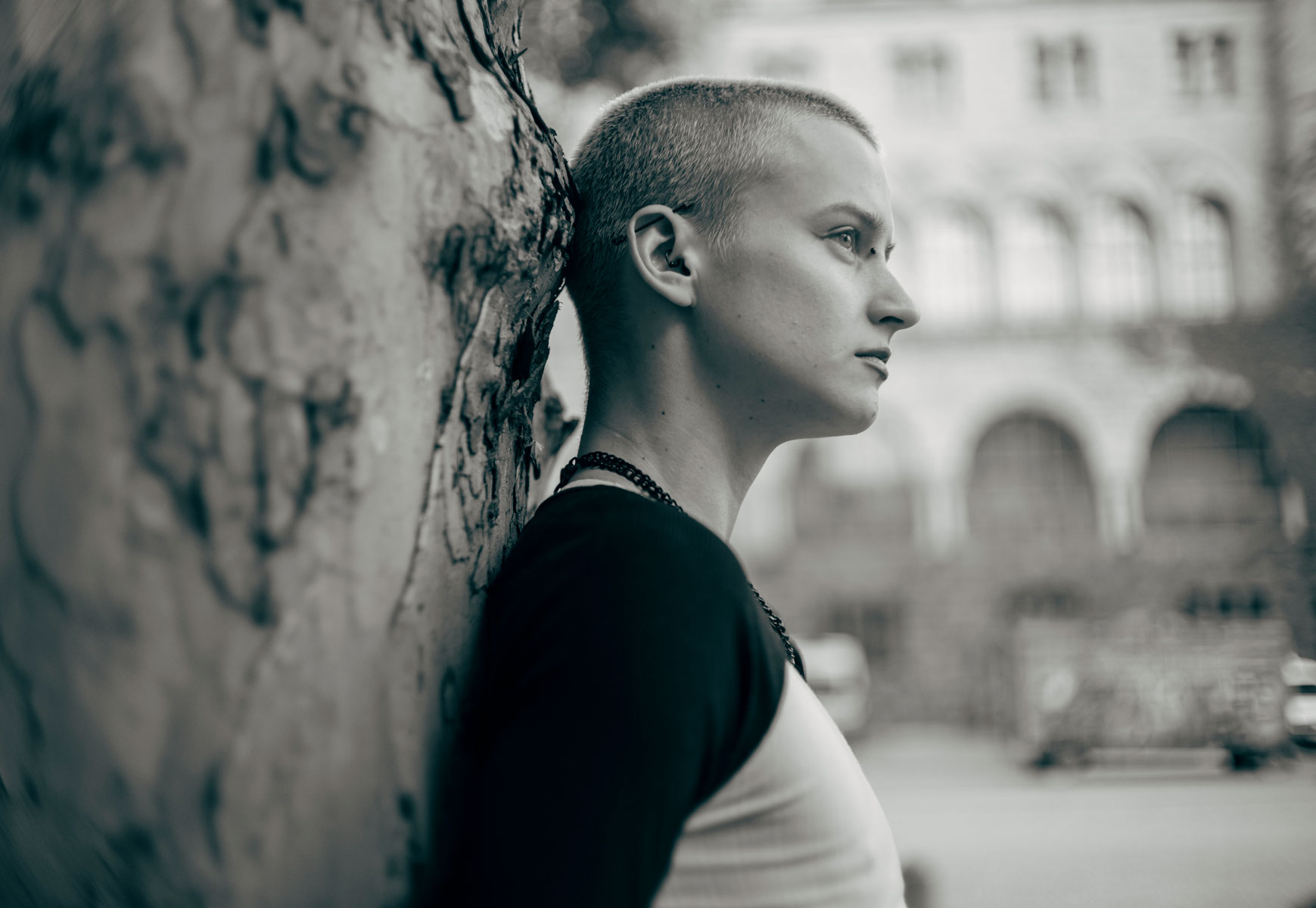


What letter are you in the rainbow acronym LGBT+?
I'm two of them, T and G, although I think I prefer to just identify as queer because it's a broader term.
Since when have you been using that label?
I realised I wasn't straight well before it came to me that I wasn't cisgender, though it's not a long story - I'm only twenty-two. Overall, I figured a lot of things out later in life because I had other issues to deal with first.
Such as?
The biggest challenge was to sort out my feelings after my mum passed away. She died when I was fourteen, a young adolescent. Her departure hit me at the worst possible time and consumed my thoughts.
Where did it all play out?
I grew up in Baranowo, on the outskirts of Poznań, in a very diverse community. Long-time rural residents lived there alongside newcomers who bought suburban homes. One of my classmates, for instance, was the daughter of Piotr Reiss, the famous footballer. It was quite a mix of people.
Any LGBTQ+ people in this suburban mix?
In middle school, a girl came out as a lesbian, which sparked all kinds of rumours about her, many of them hurtful. My friends and I decided to explore our own identities together. One of these friends, who is also transgender, and I are still in touch. They were my main support during that time, especially after I could no longer turn to my mum.
Could you rely on your dad?
I used to find it hard to talk to him, especially about these things. My mum's passing brought us closer, but it took us years to get there. Meanwhile, in middle school, I realised I was queer, that I didn't fit into the clothes or labels assigned to me. This was way before my transition, so people saw me as a lesbian, but that wasn't me. I felt like an actor playing roles scripted by someone else. In middle school, these roles were first of a girl and then of a lesbian.
When did you feel you had to start writing your own script?
Towards the end of middle school. That's when I participated in my first Equality Parade in Poznań. It was intimidating, yet fascinating. I painted my face in multiple colours, made a banner from a bedsheet, and took a public bus from Baranowo. It marked a bold step forward, coinciding with the start of high school at St. Mary Magdalene Secondary School in Poznań.
In the book "A Different City", I interviewed Piotr Mazurkiewicz, a biology teacher there. Did you have him as a teacher?
No, I was in a humanities class, but I remember him from the time we checked out the entire staff at the beginning of school. His shirts stood out, and we had a feeling he might be queer.
How was your time in Marynka?
I met many queer people there, though we didn't openly discuss it yet. I was still exploring and figuring out my identity, thinking things through.
Did you still identify as a girl back then?
Yes, I didn't realise I was a transgender boy until the end of high school. I vividly remember my astonishment at the famous Margot arrest in Warsaw and everything that ensued. It grabbed my attention because someone was finally speaking out about approaching gender differently. This resonated with me, prompting deeper reflection on my own identity.
What about your name at the time?
It started to bother me more and more, so I switched to a gender-neutral version, and that's how Jul came about. I increasingly used male pronouns to refer to myself. It felt affirming and liberating in small ways.
How would you describe your relationship with your body then?
My body felt like a house undergoing renovation, or rather, a full-blown remodelling. During college, seeing a transgender friend undergo hormone therapy sparked envy in me. I felt a strong desire to follow suit, sensing that my own "house" badly needed an overhaul. At the same time, I feared the potential backlash of openly expressing myself.
Did you share this with anyone? How did they react?
The first person I opened up to was a transgender friend from middle school. She was surprised but incredibly supportive, offering invaluable help. This encouraged me to confide in other friends, university peers, and professors, creating a cascade of understanding and acceptance.
Was the reception generally positive?
Very much so. Perhaps because I attend a fine arts university where my field of study is pursued by few. The teachers apologised in advance for any initial mistakes with my pronouns but assured me they would get it right in time. That was perfectly fine because every change takes time. No one had issues with the evolution of my first name -from Jul to Jules and finally settling on Julian. Today, I joke that all there was to this first name transition was adding an "n" to my deadname. So I have a new name, but it also has my old name in it. And I actually like it very much, because it reflects my entire journey.
How did your family react to your coming out?
My family of choice has been incredibly supportive, but my biological family hasn't always been perfect. My brother, who's a psychologist, needed time to process the news but is okay with it now. However, my dad, who is conservative and religious, said he put faith before children, which was deeply hurtful - it felt like losing another parent. Things have since improved between us, which is probably why I'm comfortable talking about it now. Recently, when my dad visited from Konin, where he had just moved, he said that he had thought this over. He apologised and committed to using the correct pronouns. We both were on the verge of tears.
This underscores the importance of giving loved ones time to reflect and adjust to change rather than writing them off immediately and labelling them as transphobic.
My therapist once shared similar advice, so I'm grateful that things turned out positively, that I didn't succumb to suicidal thoughts two years ago and can honestly say I'm happy.
Does Poznań play a significant role in this journey?
I think it does. It is not known as the rainbow capital of Poland for nothing, and living in a city with a vibrant queer community feels comforting and makes a huge difference. Many of my friends, some even from Warsaw, are envious, but I think support can be found in smaller towns too - it depends on people. For example, my former partner, who is also transgender, received tremendous support from specialists in Gorzów Wielkopolski. Call me idealistic, but I truly believe there are good people everywhere.
Why did you choose to study animation at the Poznań University of Fine Arts?
Firstly, I want to clarify that it's film animation, not cultural animation. Why did I choose it? I'm passionate about cinema, movement, art, and music - all of which converge beautifully in film animation. I have been creating things for as long as I can remember, often sketching in school notebooks, much to the dismay of my teachers. My parents have always supported me in this, and I'm grateful for their encouragement. They even enrolled me in an animation class at the Zamek Cultural Centre during middle school. Looking back, I feel like this path was meant for me.
Did you apply anywhere else besides the Poznań University of Fine Arts?
I also applied to the Kraków Academy of Fine Arts, which offers a major in graphic design with a specialisation in animation. I was accepted to both, but Poznań was my top choice, and I'm now in my third year here.
Are your studies what you expected them to be?
For the most part, yes, although the first year was challenging due to identity issues that affected how I expressed myself artistically. I don't share my early works with people because they reflect that turbulent time. Initially, I wasn't sure if I could do it, but I'm now happy that I persevered and made progress.
What will your bachelor's thesis be about?
I am conducting an experiment in a virtual reality that I designed, which users navigate with special goggles and controls. The virtual space is a cloud-like world inspired by my childhood memories, featuring sounds recorded in places that relate to my childhood. I find this project incredibly fulfilling, and I'm considering expanding it into a longer original animation.
Are you financially independent?
No, my dad supports me, and I also have a job. When Lokum Stonewall was still on ul. Półwiejska, it became the first queer pub in which I openly worked as a transmasculine person, which was amazing. I need money not only for the usual expenses like rent and food but also for aspects of my transition - specialist medical consultations, hormone therapy, and chest surgery, which I underwent a year ago in Szczecin under the care of Dr. Katarzyna Ostrowska-Clark, whom I highly recommend.
When did you start your transition?
I have been on hormone therapy for two years. The trans friend I mentioned earlier recommended an excellent endocrinologist in Poznań, Dr. Katarzyna Ziemnicka. Before updating my birth records, I also legally changed my name to Jules at the Civil Registry Office in Gdańsk.
Why Gdańsk and not Poznań?
It was easier and friendlier there. The Poznań Registry Office doesn't have a good reputation among queer people. When I dealt with them after completing the court process for gender reassignment - which unfortunately requires suing one's parents, and in my case, my dad - I felt humiliated. I've never encountered such cisplaining anywhere in Poznań. I received significant legal assistance during this process from Mikołaj Świstowski, an attorney affiliated with the Kraków Signs of Equality Federation, who offered to help me pro bono. He's in high demand now, with a long queue of people seeking his assistance.
Did the legal proceedings go smoothly?
They did. I now have new documents for Jules, no longer Juliana. Recently, when I went to Marynka to update my name on my graduation certificate, the clerk lady there looked up at me and said with a smile: "You look even more beautiful!"
That's wonderful.
It was even better when my boyfriend, who is also transgender, flirted with me. It's truly fulfilling to be able to embrace my authentic, happy self.