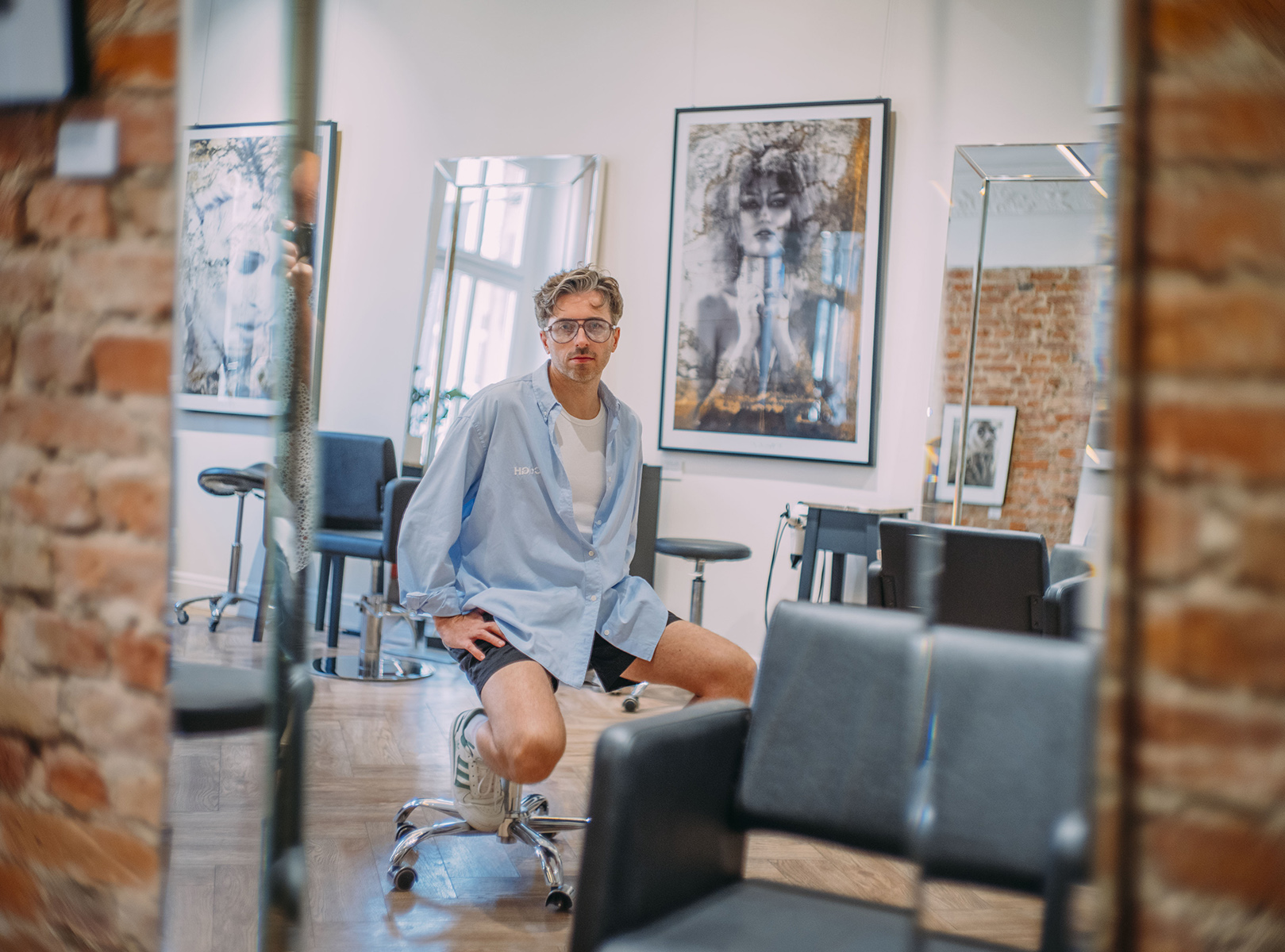


Not only are you gay, but also a hairdresser - it seems you're living up to a common stereotype.
What can I say? I've just got to roll with it. But honestly, there are plenty of straight hairdressers, even though this line of work has long been considered a women's domain. Even back when the most famous hairdressers were men, such as Vidal Sassoon or Antoine de Paris. When I decided to become a hairdresser in the early 1990s, half my family laughed at me, and so did almost everyone at the vocational school I attended.
Was choosing hairdressing at a vocational school a form of coming out?
For some people, probably yes, though it was something you only whispered about back then. We weren't free to discuss it openly - neither at my school nor the two others where I apprenticed, first for four weeks at one, and then six weeks at another. The former was in Zgorzelec, where I was the only boy, the latter in Świebodzice near Wałbrzych, where six of us learned hairdressing alongside a bunch of carpenters, so you can imagine how much fun that was.
Did the carpenters get along with you?
They did, despite the usual fag jokes.
Before we go any further, I want to ask you about the term "barber", which is increasingly being replaced by "hairdresser" or "hair stylist". Do you identify as a barber or a hairdresser, and does it even matter?
It doesn't matter to me - you can call me either of these two. Recently, the term "czeladnik fryzjerstwa" ("hairdressing journeyman") has been making a comeback. I actually have that title on my certificate. Nowadays, when you first start out, you're called a barber, but once you reach a high level, you graduate to stylist or hairdresser. But that's not a hard-and-fast rule. There are plenty of self-proclaimed stylists on TikTok whose skills are clearly lacking.
How old were you when you set your sights on becoming a hairdresser?
Thirteen, I think, I was in the seventh grade of primary school when I started thinking about what to do next. I didn't want to go to high school and then college because academic studies wasn't my thing. I wanted a specific trade, so I chose a vocational school, and I've never had any regrets or felt ashamed of it, even though I know vocational schools don't have the best reputation.
Where were you living at the time?
In Zielona Góra, where I was born and raised. I had a great childhood, wonderful parents, and a brother who's seven years younger than me. My dad worked in the police, and my mom was a waitress and bartender in the best pubs, and later also a cafeteria manager. Thanks to that, during the communist era, we were always stocked up on meat, coffee, and other goodies. Plus, our neighbour was a Pewex[1] manager, so we were pretty well-off! My brother, who's an excellent bartender, followed in my mom's footsteps - he teaches bartending, judges international competitions, and runs his own cocktail bar in Zielona Góra with his partner. As you can see, our family values skilled trades.
When did you first realise you weren't straight?
We'd have to go back to that vocational course with the carpenters. At the time, I had a girlfriend, Kasia, who was also in training to be a hairdresser. Kasia was quite the character - tanned, lots of jewellery, an amazing hairstyle, and always perfectly styled. She caught the eye of one of the carpenters, who started hitting on her. The plot twist? I developed a crush on him. It was there and then that, you could say, I realised I was gay.
What a great story.
It still makes me laugh.
Hairdressing is a hands-on profession. Where did you get your training aside from the vocational schools?
I apprenticed with Mrs. Maria Stołpiak in Zielona Góra. She ran a small hair salon and was the one who really taught me the trade. I worked with her several times a week for three years, starting with the simplest tasks, of course. Then one day, she said, "Darek, the next client that shows up is all yours - you're going to wash her hair." And guess who walked in? My mom, wanting to see how I was doing. Well, I did my best, but I ended up soaking her back when I washed her hair.
I bet the first haircut was even more nerve-wracking.
Absolutely. Once you cut someone's hair, there's no turning back. My first client was my brother, and we ended up having to go to another barber to have his head shaved down to a six-millimetre buzz cut. Even after the shave, you could see uneven spots here and there.
Learning through mistakes is the way to go.
Exactly. One time, Maria gave me a special hair lightening powder used for foil highlights. She told me to practice on my aunts, and I did until I ran out of the powder, which is when I bought a Polish substitute. I used it to do highlights on my neighbour's friend, and she suddenly complained the foil burnt her. I touched it and it was indeed hot - her hair underneath was completely fried and fell off as I unwrapped the foil. Maria laughed, just like you are now: "Darek, you must never use that powder with aluminium foil!" That's how I learned the trade.
How many such casualties did you have?
I lost count, but it was definitely worth it.
What was the next step in your hairdressing career?
A large chain, Gabriel beauty parlours, was moving into Poland and hiring young hairdressers. I applied, passed the practical exam, and got accepted into an eight-week course taught by top Italian hairdressers. It was an amazing experience that opened my eyes to what hairdressing could really be. That's when I first got exposed to the world of celebrities, fashion shows, and photo shoots. Then, in the mid-1990s, I decided to move to Poznań, which I was already familiar with from childhood visits.
Was it a happy transition into adulthood?
Not exactly. On my way to the Gabriel parlour for the exam, I had an epileptic seizure on a city bus, which led to a diagnosis of epilepsy. I was put on a medication, but it left me feeling groggy all the time. And so after two years, I discontinued it. Eventually, I had another seizure and, long story short, I was diagnosed with a glioma in my left hemisphere. It seemed there wasn't much to do except wait for the inevitable but then Maciej Krajewski from the Łazęga Poznańska Association, who works as an oncology nurse, recommended a specialist in Bydgoszcz. I went there with my brother, who turned out also to have a glioma. He underwent surgery first, after which I had two operations. Thankfully, we're both still alive today, though our annual check-ups are always nerve-wracking. Since the diagnosis, I've decided to live life to the fullest, making the most of every moment.
And live in Poznań. Have you ever considered moving to Warsaw at the start of your career?
Yes, the idea did cross my mind more than once. In the early 2000s, Jaga Hupało, who I was already working with at a Poznań hair salon, offered to hire me and Piotr Bocian at her soon-to-be-opened parlour in Warsaw. But things dragged on, and in the meantime, Piotr and I started thinking about setting up our own business. The funny thing is that the two of us didn't get along at first and competed for the same clients. But eventually, we became friends and then business partners, owing to our mutual desire for self-growth. In 2000, we opened our Hair Bazaar Studio.
Where did the name come from? Poznań already has a Bazar that plays a vital role in the city's history.
Our Bazaar, spelled with two "a"'s, was inspired by Harper's Bazaar magazine. But you're right, it also ties nicely with the historic hotel in the centre of Poznań.
You opened the studio on ul. Krysiewicza, which wasn't exactly a popular neighbourhood back then.
We chose that location because we found a 300-square-meter, two-story space that was perfect for our purposes, even though it was in a part of Poznań that people generally steered clear of at that time. But that didn't deter us, and the area started to improve quite quickly, thanks in part to Grażyna Kulczyk, who was already a client of mine back then. She used to come in every day at ten to seven for a wash and a style. One day, she showed up with her daughter and said, "Darek, we're neighbours now. I bought the park next door and we're starting the renovation of the Old Brewery." The brewery, which completely transformed this part of the city, is now an iconic building.
Did many people think you and Piotr were a couple?
Of course, but we were never romantically involved - we were just friends and business partners. Piotr actually came out very quickly. He was probably around fourteen when he told everyone he was gay, and he's always lived openly.
And you?
I struggled with it for a while, mainly because I feared rejection, especially from my loved ones. That's why my coming out happened later, when I was already an adult and earned my own living. My parents actually found out when Piotr, his partner Krzysztof, and I were going to a grape harvest job together. It wasn't hard to figure out. But there was no rejection from my relatives; my parents know my gay friends and have no problem with them. The same goes for my brother. I told him I was gay when I got drunk after breaking up with my boyfriend. He asked, "Why are you being so weird today?" I replied, "Because my boyfriend has left me!" We had a drink together, and that was my coming out. I was about twenty-four at the time.
It sounds like you were pretty busy during that time.
Yes, Piotr and I always worked a lot, sometimes ten to twelve hours a day. It's still the same today, as it should be. And I'm not complaining - I'm happy to be busy, and we always have lots of business. We're usually fully booked for the next two months.
Hard work alone doesn't fully explain your success - there are plenty of other hardworking hairdressers in Poznań who are much less successful. What's the secret of your Hair Bazaar Studio?
I think it's our openness and vibrant social life. We've always held lots of events, fashion shows, and parties, wanting our place to be more than just a hair salon. We've also trained many people in the trade, and a lot of them now run their own salons in Poznań. Of course, it's hard to see someone leave after you've invested in them, but that's just the way it goes. At first, I didn't handle it well - I blame myself for someone's leaving. But then I realised that this is how our profession works. After all, I left my previous jobs too. The manner in which someone leaves is important, though - there's a classy way to do it and a not-so-classy one, and we've seen both. But we also have people who have been with us for many years.
Did it matter that the salon was founded and run by two gay men?
I think it had a big impact, especially in the beginning. Twenty-five years ago, being gay was still a bit exotic. For some people, going to a gay hairdresser was a way to show their openness; for others, it was socially appealing. And some women believed that gay men could better bring out their beauty because we see them differently.
Did you experience homophobia in Poznań?
Apart from the occasional insult, nothing terrible ever happened to me. I actually have lots of funny stories to tell. For example, a woman once brought her son for a haircut - this was before we had our salon - and said, "You know, we used to go to this guy named Tomek, but he's gay, so we had to stop going." I just smiled, gave her son a haircut, and when she was paying, I said, "You know what? You won't be able to bring your son here anymore because I'm also gay." Piotr, his client and me had a good laugh about this, and the woman never came back.
Is Poznań a different city today?
Absolutely, a far cry from what it used to be. When I first moved to Poznań, I attended a gay party that I distinctly remember being held in a milk bar in Grunwald. Imagine that - a gay party in a milk bar[2]! Like in Marriageable Girls[3]! That's where I met Tomek Nikita, the same Tomek that the homophobic lady and her son stopped going to. I also remember Grobla, a pretty rough neighbourhood at the time, having an underground gay pub - a small, sketchy place in a basement with a toilet behind a curtain. We've come a long way from those dingy basements to having a gay pub in the Castle.
When did you start going to equality marches?
Not until later, actually - only when the Stonewall Group began organising them. I didn't feel the need before, but now I have a lot of fun at the marches. And I'm not alone. More and more people from across Poland come to Poznań for the Equality March, and I often hear that Poznań is the most queer-friendly city in the country.
Have you ever wanted to leave Poznań?
There was a time when we considered it. Piotr and I thought about opening a second salon in Warsaw. The plan was that I'd run the one in Warsaw and Piotr would stay in Poznań. But we eventually decided against it. I visit Warsaw quite often. When I had a boyfriend there, I would go almost every week. But Poznań has won out in the end, and I'm very happy with that decision.
What's trending in the hairstyling world these days?
There are lots of trends, and many of them keep returning. For example, hairstyles from the 1990s and 2000s are making a comeback. The days when half the country would wear the same hairstyle that happened to be in fashion are long gone.
Do you always grant clients their wishes?
Their requests are my inspiration. Generally, I'm open to clients' ideas, but if I think something isn't right, I won't do it, I have to decline. Some people take offense in that, others go elsewhere to get what they wanted, often with disastrous results. But those instances are rare. About half of my clients have been coming to me for years, even if they've moved to other cities.
Does this mean Hair Bazaar Studio doesn't need to advertise?
There's no better advertisement than word of mouth, a referral from a satisfied customer. Plus, after so many years, we've established ourselves as a strong brand in Poznań.
For the past three years, the studio has been on ul. Święty Marcin, and no longer on ul. Krysiewicza. Why the move?
The old location, where we spent over twenty years, needed a major renovation, but the building's owner wouldn't approve it. So, we decided to find a new one. Surprisingly, the move wasn't difficult, which made me realise it was the right decision. Recently I visited our old spot on ul. Krysiewicza because a friend of mine opened a restaurant there after moving her La Bottega from Św. Wojciech. It was funny to sit at a table where my workstation used to be after all those years.
In December 2023, Piotr Bocian passed away unexpectedly. You're now singlehandedly running the business you both created and managed together for years.
His death hit me hard. For about two months, I had no idea what to do next or how to carry on without the person I'd been friends and run a business with for close to three decades. But eventually, I had to move on because life doesn't stop, and I had to find a way to manage things on my own. I think everything is going well now and is going to stay that way. I'm work even longer hours now, but I still enjoy what I do, which in itself feels like quite an achievement after all these years.
[1] A chain of shops in communist Poland that offered Western goods unavailable in regular Polish shops. The goods were available exclusively for Western currencies
[2] Milk bars were cafeteria-style establishments in communist Poland subsidised by the government to provide affordable, nutritious meals to the public. They were known for their no-frills, utilitarian atmosphere and were a staple of daily life for many people, especially those who couldn't afford more expensive restaurants.
[3] A 1972 Polish film directed by Janusz Kondratiuk. This light-hearted comedy follows the story of three young small-town women who spend a weekend in Warsaw, hoping to meet eligible bachelors and experience the excitement of the big city.