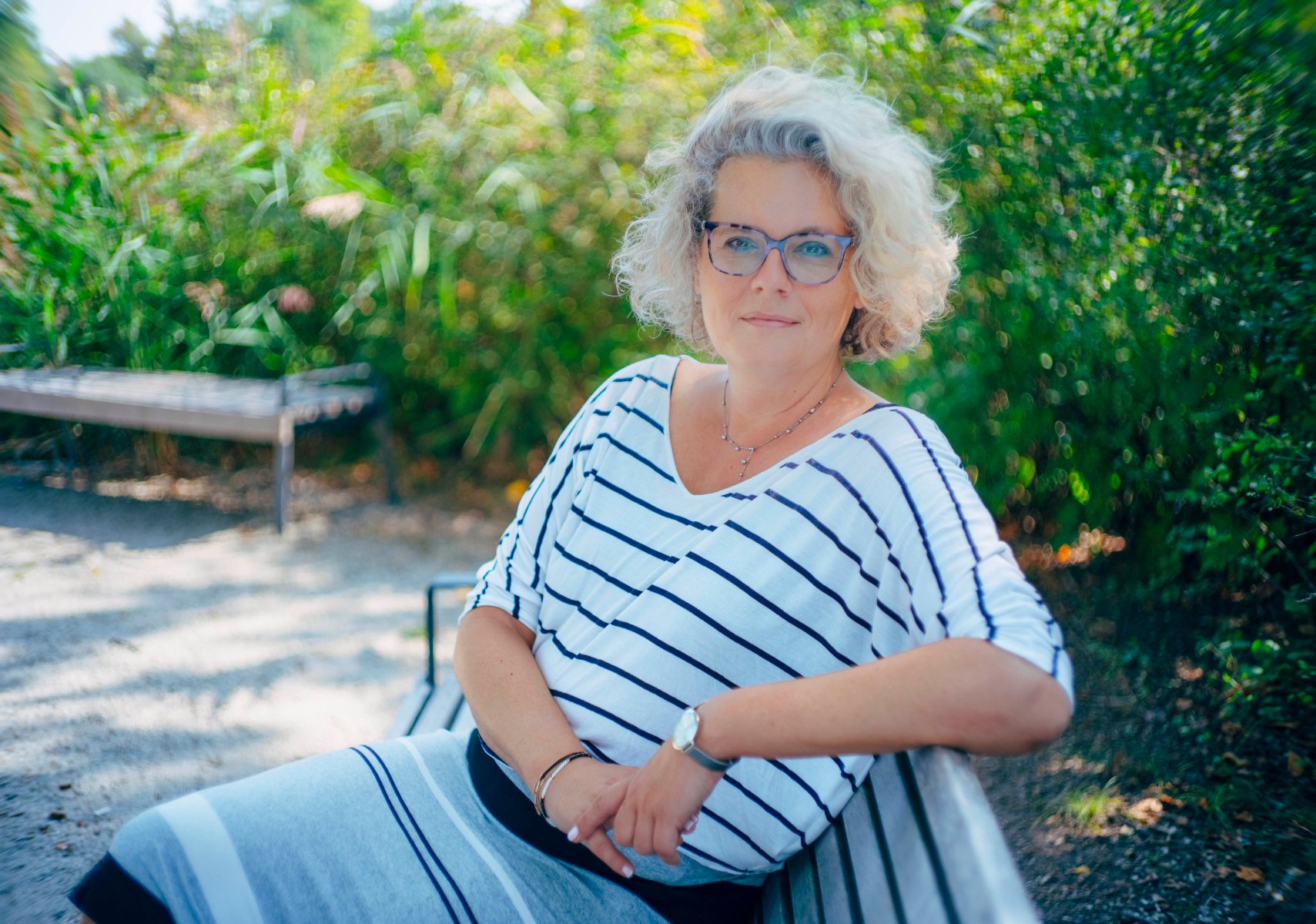


"She's long past her transition, she's managed to save herself": Is this about the protagonist of your book Gdy słońce wypieka sny[1] or about you?
Both, the book is autofiction. I saved myself a long time ago.
How long?
Twenty years. I started thinking seriously about transitioning in the early 2000s. By late 2004, I was ready to go ahead. First, I contacted Prof. Maria Beisert from the Faculty of Psychology at AMU[2], who's now the head of the Polish Sexological Society. She referred me to a free psychotherapy clinic in Warsaw, where I spent two years going through all the necessary steps for transitioning. Less than a year after starting hormones and blockers, the results were already visible - basically, it happened almost instantly. I always had a very feminine appearance. After that, I began the legal process to change my documents, which involved a court case against my parents, as required by Polish law. And then, it was done.
From the way you describe it, it sounds like everything went smoothly and professionally, which of course makes me happy, but a bit surprised.
That's pretty much how it went, and honestly, I was surprised, too. But even though my transition went smoothly, I still had tough conversations with my loved ones and dealt with the usual anxieties. Once I got my parents' green light, though, everything moved quickly. The whole process was done within three years.
What do you mean by the green light from your parents?
I had long, heartfelt discussions with them. I really wanted them to understand my transition and support me. At first, the conversations were very emotional, and it was the first time I ever saw my father get teary-eyed. My mother was terrified, but more about the awful things she feared might happen to her child. As time passed, the emotions faded, and our talks became more practical. Eventually, they said, "Go ahead, we're with you," and they really did support me wholeheartedly.
How old were you when you broke it to them?
About twenty-six, maybe twenty-seven.
Is this considered late?
I recently exchanged emails with an old friend. I'd given her a copy of my book, and after she read it, she told me she loved it but wished she hadn't waited so long to transition, worrying about how it would turn out. Many transgender people feel this way. I told her I transitioned when the time was right for me. The truth is, everyone has their own timing, which depends on both personal readiness and where they are in life. If I were from her generation, my transition might've been seen as early, but from today's perspective, it might seem late.
Late due to circumstances?
I've always known I was transgender, really. Like many people, I tried to deny it, but you can't deny who you are for long. You can't live that way. I finally faced that reality when I was in my early twenties, while I was writing the youth section of my book. I realised I had to either go through with the transition or end my life. I chose the path that started this whole conversation: saving myself. And looking at me now, it was definitely the right choice.
You mentioned you've always known you were transgender. How long have you known?
I've known since I was a few years old, though I didn't know the term "transgender" at the time. But, as I said, I've always had a lot of feminine traits. In fact, until I hit puberty, I could pass for a girl based on how I looked.
Did it cause you any suffering?
Sure, but only occasionally. Honestly, I remember the good moments far better, like at summer camps when I always had an unofficial "boyfriend", someone who secretly admired me, blew me kisses, and held my hand. It felt good, though a bit strange, as I presented as a boy but was treated like a girl. I've felt in between for as long as I can remember.
Are you a native of Poznań?
Yes, I was born here in 1976 and grew up in a block of flats in the Winogrady district. I'd hang out by carpet beater racks or on yard benches, playing French skipping with the girls. My dad was a university professor, a graduate of the Poznań University of Technology, and spent his entire career at the Poznań Institute of Rail Vehicles, now the Modern Mobility Centre. My mum worked in various administrative roles in the public sector. I have an older brother too, but he's gone his own way and we're not in touch. It's nothing to do with me being transgender.
Did you go to Marynka high school?
Yes, I did, and I was always top of my class - a top student all my life. Sometimes I wonder if excelling was a way of masking my difference, a form of compensation. I'm not sure; perhaps I'm overthinking it. Marynka was a great school. It had been shut down by the communist authorities but then reopened after the regime fell. It was a classic school for the children of Poznan's intellectuals. We were involved in arts and theatre, travelled around Poland and abroad - it was brilliant.
Did you know any queer people at the time?
No, but I do remember that when I started at Marynka, before the teachers got to know me, some would address me using the feminine form, assuming I was a girl - which makes sense now, in hindsight. While I could have been upset by it, I actually found it nice. It showed that many people were confused about my gender just from meeting me. I also recall in the second or third year, I was called in to speak with the PE teacher because I kept skipping classes. She told me I should probably be doing PE with the girls, not the boys, because I was so feminine and probably felt uncomfortable with the boys. She saw right through me, Mike!
What did you say?
I was stunned and a bit frightened, but deep down, I took note. More and more people were beginning to see me for who I really was. Even though, when I became an adult, I buried my true self for a while and lived as a man.
Why did you do that?
I didn't think I could cope otherwise.
Couldn't you talk to anyone openly?
No, I couldn't. Everything stayed bottled up inside, which of course led to depression. It remained that way until I was doing my doctoral studies in France. I'd come home from university and start writing, and that's when my book began - it was a form of self-therapy. Getting everything out, putting it on paper, and really looking at myself was incredibly liberating.
Did you have any relationships?
I had a few, both in Poznań and France, but before transitioning, I suppose they could be called gay relationships. I didn't feel comfortable in them because I didn't feel gay, I didn't even feel like a man. It made everything dysfunctional - how could it be anything else? The turning point came when I came out to a boyfriend in France. We're still close friends today. I mention him, Sylwek, in my book. He was the first person I told that I wasn't gay, but a transgender woman. He accepted it, though he asked a million questions. We talked all night.
Did your parents know you weren't straight by that point?
By the end of my studies, they knew I was gay because I had a boyfriend and was head over heels in love with him, so I couldn't hide it. A few years later, I came out again, this time telling them I was a trans woman. Interestingly, my mum took the gay coming out better than my dad, while my dad was more open to the news that I was transgender. At least, that's how I remember it.
You wanted to go to medical school but ended up studying biology. Why?
I wasn't really cut out for dealing with patients and bodily fluids, I preferred something more sterile. That's how I ended up in molecular biology, which I pursued as a researcher. I did a PhD and then a second-degree doctorate. But I've always been drawn to languages as well. I even considered studying English and French philology, but at that time, it was only offered in Warsaw. My parents advised their "good girl" to go for something more "practical" instead.
But you still learned those languages.
Yes, I studied them on the side, took courses, and learned while traveling. I believed that as a transgender woman, I wouldn't be able to live a normal life in Poland and would have to move to the West. Poland in the 1990s was terribly homophobic and transphobic - it repulsed me. Poznań did too, to be honest. I attended the first Equality March, and I remember it well - and the second one too. The aggression, the yelling, the eggs thrown at us. In contrast, I knew Paris, a much more open and queer-friendly city. Back then, the two places were worlds apart, and it took decades for them to draw closer together. But Poznań isn't all of Poland. I don't know how long we'll have to wait for laws that legalise same-sex relationships, ensure fair transitions, and protect women's reproductive rights. It feels like we're light years away.
What was your doctoral thesis about?
I researched olfactory receptors in the tongue's epithelial tissue, as my field is molecular biology - challenging but fascinating. I work at the Institute of Experimental Biology of Adam Mickiewicz University, where I returned after completing my doctoral studies in France. I'm involved in research and teaching, covering subjects like medical virology and cancer genetics. I'm particularly pleased that I'm teaching more classes in English now, which means my passion for languages, as well as my time in France and later in the US, are paying off.
Was it after you returned to Adam Mickiewicz University that you decided to transition?
Yes, it was a very intense time, not only because I had to start the transition process we've already discussed, but also because I had numerous conversations with friends and work acquaintances.
I am curious about how the transition went in the university environment.
I had to inform my superiors, who took note of it without any issues. I explained that I had been diagnosed, that I would be undergoing physical changes, and that my personal details would change as I became Julia. My mum was very firm: it had to be that name and no other. I noticed a few disapproving looks from some of the more conservative people at the university, but those reactions faded in time. As for the students, they were obviously from a different generation, so they weren't bothered at all.
In Poland, when it comes to LGBT+ issues, we tend to expect a lot of drama. But your story - a transgender woman who transitioned twenty years ago and has been living openly and happily in Poznań since - doesn't really fit that stereotype.
There was definitely inner turmoil, but it didn't break me. I was determined to turn my struggles into a plan and follow through with it, regardless of who disapproved. I had no other choice. I only have one life, and I'm happy to live it as a content transgender woman.
I also saw you at the Poznań march for the International Day of Transgender Visibility on 31 March. Trans visibility is growing, and the trans flag is probably one of the most recognisable LGBT+ flags today, alongside the traditional rainbow one. The "T" has finally earned its place in the LGBT+ acronym.
Yes, I see that too, and I think it's a significant step in our movement towards emancipation. It's not that there are suddenly more of us, as some transphobic people believe, or that it's just a trend. We've always been here, but we were invisible, marginalised. In fact, we've had to wait a long time - at least in the Western world - to be seen in public, whereas in many other parts of the world, transgender people have always been visible. Being transgender isn't new, and that's something that can't be said enough. Another thing to remember is that many people today exist across a spectrum of gender identities and psychosexual orientations, rather than fitting into just one label. You can be T, G, and L all at once, in various combinations.
Where do you place yourself on this spectrum?
I identify as a heterosexual trans woman with a touch of non-binary identity. And, you know, I don't think that's particularly sensational in Poznań these days. This city has become very welcoming to our community. I'd even go as far as to say that we've finally caught up with the West mentally, and I hope that other Polish cities will follow suit one day.
[1] The title translates into When the Sun Bakes Dreams.
[2] Adam Mickiewicz University of Poznań