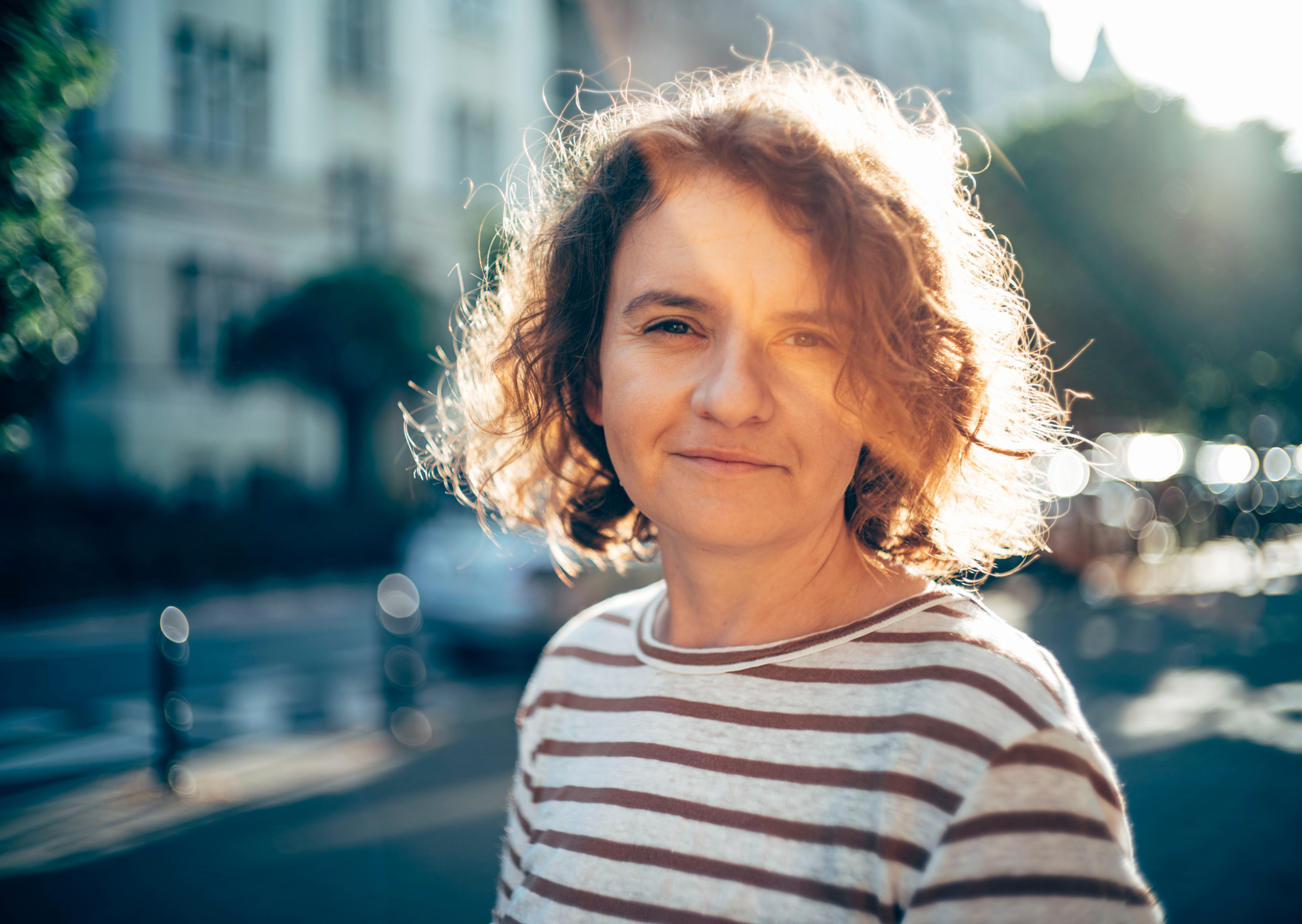


When a year ago, on the Stonewall Podcasts, we discussed your book Nie wszyscy pójdziemy do raju (We Won't All End Up in Paradise), you said that people in Poznań stared less. What do you mean by that?
In any other city, every time I'd walk down a street with a girl, I would get lots of stares. But when I moved to Poznań and took my first stroll holding hands with my then girlfriend, I didn't catch any stares at all other than a few friendly ones. This came as a big surprise to me. To this day, I'm a bit amazed that nothing unpleasant has happened to me here in Poznań because of being a lesbian.
And you do have points of comparison, don't you?
Absolutely. I've lived in Radom, Lublin, Kraków, Katowice, Warsaw, and Gdańsk. I've experienced those stares everywhere, except in Poznań. Here, I feel safe and at ease, whether at a party, in the cinema, or the theatre. This kind of comfort isn't something our community can take for granted in Poland. I have now paused to think about it to answer your question, but I don't normally give it any thought anymore, and that speaks volumes about the city.
Why do you think Poznań has gone through such a queer transformation?
Well, to start with, I wasn't part of this change. I arrived when it was already in full swing, so I don't know what it was like before. I've been living in Poznań for two years now, and I admit I was sceptical at first. I thought it was just some kind of queer-related PR for the city that the locals had adapted to, regardless of their true feelings. But this turned out not to be the case. Poznań's LGBT+ community has managed to achieve something that other cities have failed to do. It tapped into Poznań's sense of order and the widespread belief that you can be whoever you want to be. Honestly, I don't even wonder why Poznań is like that, I just revel in it.
It's especially nice in the Jeżyce district, where we both live. Borys Fromberg, the father of a transgender daughter and an Inny Poznań interviewee, says that Jeżyce was the first Poznań district to come out.
My neighbour's story is a perfect example. I've moved in with a friend in Jeżyce, and we both have dogs, so, when we walk them, we often bump into our dog-loving neighbours. Once we became acquainted, without ever discussing it, they assumed we were a couple and have always treated us as such, using "you" in the plural, as in "Will you come see us?". We have never bothered clarifying this so as not to hurt their feelings. So, while some couples pretend to be roommates, we've been playing along as a couple in Jeżyce to keep the vibe intact!
I like that very much.
I once shared this story with Dorota Kotas, who asked what would happen if one of us actually had a girlfriend. I replied that the girlfriend would just have to play along as our roommate.
But hang on, you've mentioned walking dogs, while the stereotype is that every lesbian has a cat.
Well, let's set the record straight about us lesbians. Yes, some lesbians have cats, but others have dogs. The two kinds can jokingly be described as "rival" factions. On top of that, the dog-loving lesbians often enjoy sports, while MY favourite "sport" is smoking. So, as you can see, it's a very complex world, but one that's very pleasant in Jeżyce. I ended up here completely by chance because my girlfriend had lived in this neighbourhood, but now I can't imagine living anywhere else. Honestly, I could stay in Jeżyce forever. It has everything one needs: cinemas, theatres, clubs, restaurants, pubs, a market - you name it.
Did you know anything about Jeżyce before you moved in?
About that - I have a serious confession to make. As a child, I was an avid reader of Małgorzata Musierowicz's Jeżycjada series. Back then, I imagined Jeżyce to be a beautiful, respectable place inhabited by the bourgeoisie and intellectual elite. The whole of Poznań seemed like the kind of place a girl from the provinces, like me, should aspire to live in. Of course, it turned out to be a bit different in real life - some of my ideas about Jeżyce faded quickly, while others grew stronger. And just a few weeks ago, I decided to revisit Jeżycjada, but this time as an adult living in Jeżyce.
And what do you see in the book now that you didn't pick up on as a girl?
I see a lot of strong conservatism and women stuck in stereotypical roles. The narrative about Jeżyce is full of contradictions. On the one hand, I hear people reminiscing about how great it used to be to live here, and on the other, that it was quite a rough neighbourhood. There is even a scribble on a wall near my apartment that says, "Trash Safari".
Did your neighbours ever figure out that you and your roommate aren't actually an item?
They know it now, but they can't quite accept it! They're still holding out hope that it might change. One thing has definitely changed, though - I've broken my habit of moving around Poland in search of love. Even after breaking up with the girl I moved to Poznań for, I decided to stay. I feel good here - it took me no time to feel at home in Poznań. I feel safe, accepted, and not judged, so there's no reason to leave. I'm saying this for the first time, but it's starting to dawn on me that I consider Poznań my home. And I don't think I am the first outsider to feel this way.
Many queer people who make up Poznań's LGBT+ community came from elsewhere.
This is always a good thing for a city that can otherwise become insular, with everyone having known each other forever, having attended the same schools and universities. New arrivals bring in fresh perspectives and shake up the established order. I've never heard anyone in Poznań criticise me for where I came from and for being an outsider.
You come from Radom, a city with a pretty rough reputation, which often appears in memes.
Radom is also Poland's largest city with no equality march, despite having a population of over 200,000. Pre-empting your likely question, I don't know why that is. I don't know why much smaller cities have equality marches, but Radom doesn't. As for Radom's reputation, I'd say it's become an easy target - a city that was hit hard by political changes, plagued by sky-high unemployment, and a sense of hopelessness, apathy, pain, and a complete lack of opportunities. But that's all in the past - fast-forward to 2024. Today, I think Radom's problem is that it's still a place people leave rather than move into, and without an influx of young, creative people, no city can thrive. A great example of what fresh blood can do is my dear friend Przemek Czaja. He comes from Gdańsk, but having applied for and landed the job of director of the Municipal Public Library in Radom, he has transformed the place in an absolutely fantastic way. I believe he succeeded because he was an outsider.
You were born in 1988, so you spent your early years in Radom during the rough 1990s.
That is correct, and I didn't feel safe there, even without knowing I was queer at the time. Radom launched "Akcja Małolat"[1] ("Operation Kids"), which imposed a curfew on young people from 10 p.m. to 6 a.m. That was the reality we faced back then.
And one you personally sought to escape as soon as you finished high school?
Absolutely, so I would never look back. I didn't know any queer people in Radom at the time, though when I returned with my book years later, several women admitted they had had girlfriends. That was their experience, but mine was to feel I was the only lesbian in town, even despite another one being close by all along. When in high school, I had this best friend. When we reunited a year after graduation, already living in different cities, she told me she was a lesbian, and that she'd been trying to hint at it throughout high school, but I hadn't picked up on that at all. I was definitely quite clueless back then.
What made you choose to study in Lublin?
Love. Every time you ask me why I moved somewhere, the answer is always going to be "out of love". I got admitted into a Kraków university too, and of course, I wanted to study there, but my girlfriend was in Lublin, so I followed her and ended up in a history and philosophy programme at Maria Skłodowska-Curie University.
You returned to Radom after many years in a rather ironic way. Your book Nie wszyscy pójdziemy do raju (We Won't All End Up in Paradise), which features a lesbian protagonist, won the Radom Literary Award. How did that make you feel?
It was wonderful - a delightful twist of fate and a moment of real pride to return to my hometown with my queer book and receive the mayor's literary award. In my acceptance speech, I mentioned that true hospitality includes being open to the differences of others, and until we all grasp that, we won't be truly hospitable.
Did your book, the positive reviews, and the award motivate you to become more active in the queer community?
I always feel guilty about not giving enough back to the community, so I thought speaking out might be my way of contributing. And that's exactly what happened, because for a while now, I've been writing columns for Replika, an LGBT+ bimonthly magazine.
You also wrote a piece for the first issue of the queer women's magazine LesBilans, which premiered in Poznań at Atelier Łazęga Poznańska. This magazine is the brainchild of Lesbikon, a congress for non-heteronormative women.
When I heard last year that Lesbikon was happening in Katowice, I signed up right away. The first Lesbikon was organised by Ania Matras and the Katowice Tęczówka Association, with support from the Dutch Embassy. Needless to say, I brought my book along, and it was a fantastic event filled with discussion panels, workshops, lectures, meetings, and parties. This year, the second Lesbikon took place, and it was twice as big. The event is now forming a programme board, of which I'll be a member, and the first issue of LesBilans - our magazine, featuring my article - has been published.
The article opens with, "I am a lesbian and of all the things in the world, I like sex the most".
There is a common stereotype about gay men having many partners. I'm not going to question that, to each their own. On the other hand, the stereotype about all lesbians being monogamous eternal cat lovers really bugs me. And to be clear, I'm very much in favour of everyone living the lives of their choice. I've been in long-term relationships myself, but I miss seeing content from queer women who openly admit that they enjoy sex, that it's important to them, and that there's nothing unusual or shameful about it. Judging by the lesbian community's response to my article, I'm not the only one who thinks that way. Certainly not in Poznań.
[1] Akcja Małolat (Operation Kids) was a social initiative launched in Radom, Poland, in the early 1980s aimed at reducing juvenile delinquency. In addition to enforcing a curfew for minors, it offered alternative activities, such as sports and cultural events, to keep young people engaged and out of trouble.