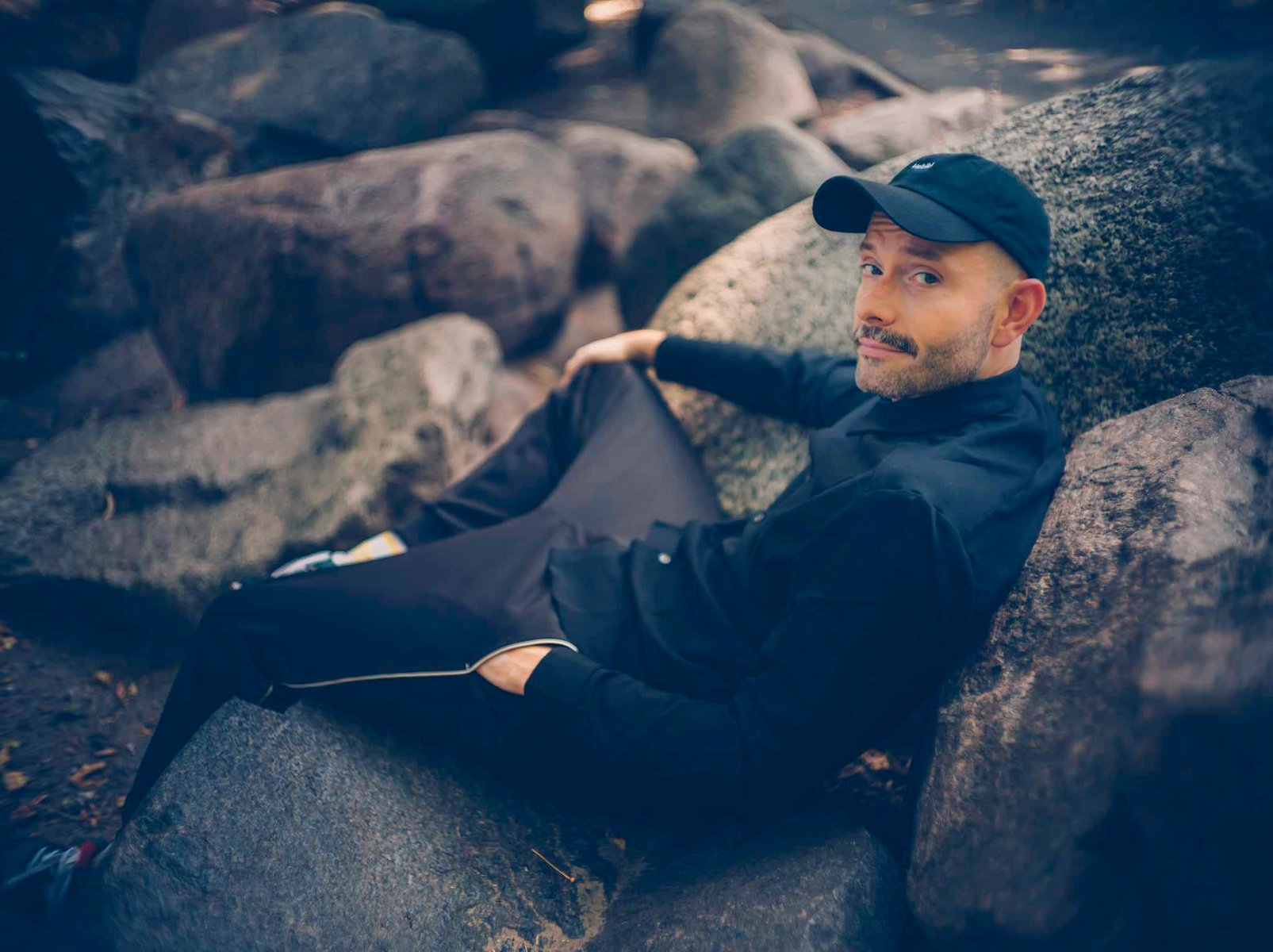


When and why did you leave Poznań?
Seventeen years ago, in 2007. The reason I left was that I really didn't enjoy living in Poznań, and all of my friends were leaving too, so I just followed suit. At the time, I had just finished a year of unsuccessful cultural studies at SWPS [University of Social Sciences and Humanities, now Collegium da Vinci], and before that, I had gone through three miserable years of high school.
What made it so miserable?
I went to a school called Paderek back then, which was the nickname for the 6th Secondary School. I'm not sure if they still call it that, but the place was extremely homophobic, and it stressed me out so much that I ended up developing vitiligo. I think pretty much everyone there, from the teachers to the students, was homophobic. I faced it every day, even though I wasn't out at the time. Looking back, it was definitely what we now recognise as bullying.
Was every day the same?
Yes, which is why I started skipping school more than more. My parents were constantly being called in to talk to the school.
Did you tell them why you didn't want to go?
No, I didn't. When they asked, I'd just say that I didn't like the school and that I was mostly into drama, which I did with some friends. For me, school was all about just getting through the final exams. Once I passed, not knowing what to do next, I enrolled in cultural studies, a major often chosen by people who have no idea what they want to do with their lives.
So, you didn't tell your parents. Did you talk to your friends about it?
I didn't say anything to them either. I was in complete denial. I still held onto the hope that I wasn't gay because everything I associated with being gay seemed negative to me.
And the friends from your drama group, none of them were queer?
Actually, they were, but we didn't use that word at the time. It was all unspoken. Nobody came out, and we were just busy with our theatre work. The group included people like Anu Czerwiński, who's now a filmmaker and performer, Andrzej Pakuła, the curator of the Poznań Pavilion, and Jędrek Burszta, a researcher and lecturer at the American Studies Centre at the University of Warsaw. We were all queer. Do you know what we called ourselves? The Different Theatre!
Different Theatre, Different Poznań. Interesting how a group of queer people could be involved in theatre, but no one ever talked about their identity.
I can't really explain it, but that's how it was. Nobody officially came out, but we all kind of knew. So, we made theatre, went to parties, smoked cigarettes, and kissed, all without ever acknowledging it openly.
Since you stayed in the closet throughout high school, I won't even ask about your time in middle school.
Actually, my middle school, number thirty-three in Łazarz District [now Secondary School Complex], was great. Probably because no one called me a faggot. It was in a fantastic building in a lovely location, right next to the Arena sports complex, where we had PE. The same building also housed the primary school I attended for two years after we moved to Poznań.
Where did you move from?
From Lubasz, a large, picturesque village about seventy kilometres north-west of Poznań. It's near a lake where I spent my every summer. My mother is from nearby Miłków. After finishing her teaching degree in Poznań, she was offered a choice of jobs, either in Wałcz or Lubasz. She chose Lubasz, brought my father along - he's an engineer from Poznań - and that's how I came to be.
Was your mum your teacher at school?
Thankfully, no. I went to the same school where she taught, but she never taught me herself.
Were you happy about your parents' decision to move to Poznań?
Not at all. I was eleven, and I loved living in Lubasz. But as I got older, I came to appreciate Poznań. If we hadn't moved, I'd probably have ended up as "the only gay in the village". And that would've been a nightmare.
So you became one of many gay people in the Łazarz district?
When I was in high school, my parents moved to Szczepanków for a bit, so I had the flat to myself. As you can imagine, my frequent theatre rehearsals and parties all took place in Łazarz. Obviously, everyone gravitates to the house where there are no parents around - it's every teenager's dream. A few years ago, I did an interview with Karolina Domagalska, a reporter and film director, for Wyborcza. She gave me this inquiring look and said, "Don't I know you? Wait, didn't I pick up my sister from a party at your flat on ul. Negolewskich?" And it was indeed me.
Oh, the Poznań crowd in Warsaw.
Janek Czapliński, who I used to sit next to at school, is now a playwright at the Dramatyczny Theatre. Jędrek Burszta, as I mentioned earlier, works at the American Studies Centre, and then there's Anu, probably the most interesting case. He looked me up after moving back to town from a few years studying at the Sorbonne. He'd left as Ania - he agreed to this deadnaming - and came back as Anu. Together, we started a studio in the space formerly known as Nowa Jerozolima. What's interesting is that most of us only came out after leaving Poznań.
Let's get back to Poznań.
My time in Poznań can be split into two phases: before and after Extravaganza, a play we put on at the Polski Theatre with Joanna Drozda and Jędrek Burszta. The "before" phase ended when I finished secondary school, and I couldn't leave Poznań fast enough.
Didn't you go to any gay spots back then?
I did, but - get this! - I went with a straight mate. He and his friends would go to Voliera because it was known for having the best parties. I was still in the closet and had no clue how to fit in, but that's when I made my first openly LGBT+ friends.
Where do you think this reluctance came from?
I think it was fear. I associated being gay with fear, so I avoided it and found a sense of safety in the theatre world.
What was your plan when you moved to Warsaw? Did you want to get into theatre?
I signed up for Iberian studies at the University of Warsaw and the Warsaw Film School, because, alongside theatre, film was my other big passion. Even in my amateur theatre days, I used to make video presentations. I loved it and saw it as something I could pursue as a career. I chose Iberian studies to get what they call a "solid education" as a backup plan. After moving to Warsaw, I shared a flat with a group of friends-unsurprisingly, most of them were from Poznań-and started exploring the city. I studied and worked at a cinema in Sadyba, which came with the perk of free access to all the films.
Were you openly gay by then?
A few trips to London and the film Before Night Falls by Julian Schnabel helped me come out. In the film, Javier Bardem plays a gay poet in Cuba during the revolution, and I must have watched it a dozen times. While I was still living in Czerniaków, I decided I wanted to do what Bardem's character did: cruise around Havana in a convertible, picking up Cubans. I wanted that to be my life, and it felt like the right time to break free. It was like a package deal for me. Not only did I come out of the closet, but I also left the church. Since then, my life changed dramatically. I wanted to come out everywhere: at school, on the bus, in shops, at the hairdresser's, on the street, you name it. Fear turned into pride almost overnight. I finally started living as an openly gay man, surprising quite a few people who had known me before.
Did your parents know at that point?
I told them about two years after I moved to Warsaw. I don't know why it took me so long. I guess I was still scared, haunted by my experience in Poznań. I must say, my parents were quite shocked when I told them I had a boyfriend and that I wanted them to meet him. I even had a joke ready: "Never mind if it's nature or nurture, either way, it's your fault!" They laughed, but of course, they needed time to process it. I think their biggest worry was that being gay would get me into all sorts of trouble, but I'd already been through the worst. I remember we stayed up late talking over a bottle of wine, and when we woke up the next morning, we found our dog had died. It felt symbolic, like I was burying my old life with him.
Who was the guy you wanted to introduce to your parents?
We met at the Dwa na trzy queer bar, tucked away in the back of a tenement building on ul. Bracka. I've seen you there, so I'm sure you'll remember it. He was a bartender, and I kept going back until I managed to pick him up. At the time, I was deeply involved in theatre, often working on queer-themed productions. That's when we staged Bańka mydlana (Soap Bubble) at the Dramatyczny Theatre.
I've seen that play. At the time, the Dramatyczny Theatre was run by Paweł Miśkiewicz and Dorota Sajewska. Your show, directed by Andrzej Pakuła, was based on a script from an Israeli film by Eytan Fox about a group of queer friends in Tel Aviv, one of whom falls in love with a Palestinian.
The blend of queer themes and theatre was perfect for me, and I even got to operate the camera. Plus, it was my first paid theatre job. One of the people working at the theatre back then was Kaśka Szustow, and it was through her that I started collaborating with Pomada, a queer collective she co-founded with Karol Radziszewski and others. In a way, I became part of building a world in Warsaw that I had been too scared to even approach in Poznań, because I had been taught it was something bad.
Did everything change in 2015?
I came back to Poznań at the end of 2015 after Joanna Drozda invited me to work on the first Extravaganza at the Polski Theatre, a cabaret show about Poznań. Of course, we had no idea at the time that it would become such a hit, leading to more editions of Extravaganza as people in Poznań finally felt ready to laugh at themselves. We made jokes about anything and everything, feeling a fresh energy in the city, which was undergoing a noticeable social transformation. Curtains that had once been drawn tightly across the city, hiding people's lives, began to open. It became clear that you didn't need to conceal who you were or who you were with anymore - you could just be yourself without fear of repercussions. Poznań simply became a much nicer place to live.
How amazing that, after being traumatised by Poznań's homophobia, you returned years later to take part in its transformation into the queer capital of Poland.
As you know, Extravaganza was very queer from the outset, and that was intentional. It's just who we are, and that's how it turned out. When we put on the first edition, we really didn't know what sort of reaction to expect. But it turned out that there was a big audience in Poznań ready to laugh at themselves and their city. Even better, they were open to turning that laughter into self-reflection. And the humour wasn't about mocking others or being aggressive-none of that. We didn't want mockery, and we wouldn't have allowed it.
In the second Extravaganza, I was invited to perform as a guest, in drag. Joanna Drozda introduced me as Florence Foster Jenkins Jeżyc, and I sang my own ballad about Poznań, accompanied by Michał Łaszewicz. The final stanza was about an affair between Jacek Jaśkowiak and Robert Biedroń. They were both in the audience, both laughing their heads off.
Neither of them took it too seriously, and the bit about them became a staple of the show. I also remember that President Jaśkowiak saw Extravaganza About Power - which is the full title - several times, always bringing important guests along. It showed that the city was heading in a completely different direction. At several points in the show, we said Poznań was Poland's most open city, which, of course, was a cutting joke at the time. Today, eight years later, it really has become that kind of city, which is a massive change for someone who grew up there.
You visit Poznań often, and we've done plenty of queer and cultural projects together. Do you remember when you first realised the city had changed?
I remember it clearly. It was late June 2022, when the Stonewall Bookstore opened next to Lokum and Duże Lokum on ul. Półwiejska. The whole ul. Półwiejska and ul. Kwiatowa intersection looked unreal - everything was rainbow, and everyone was queer. And what's more, this was all happening just down the road from Paderek, on ul. Krakowska. I thought it was such an irony that the same Poznań, which had once driven me away with its homophobia, was now awash with rainbows.