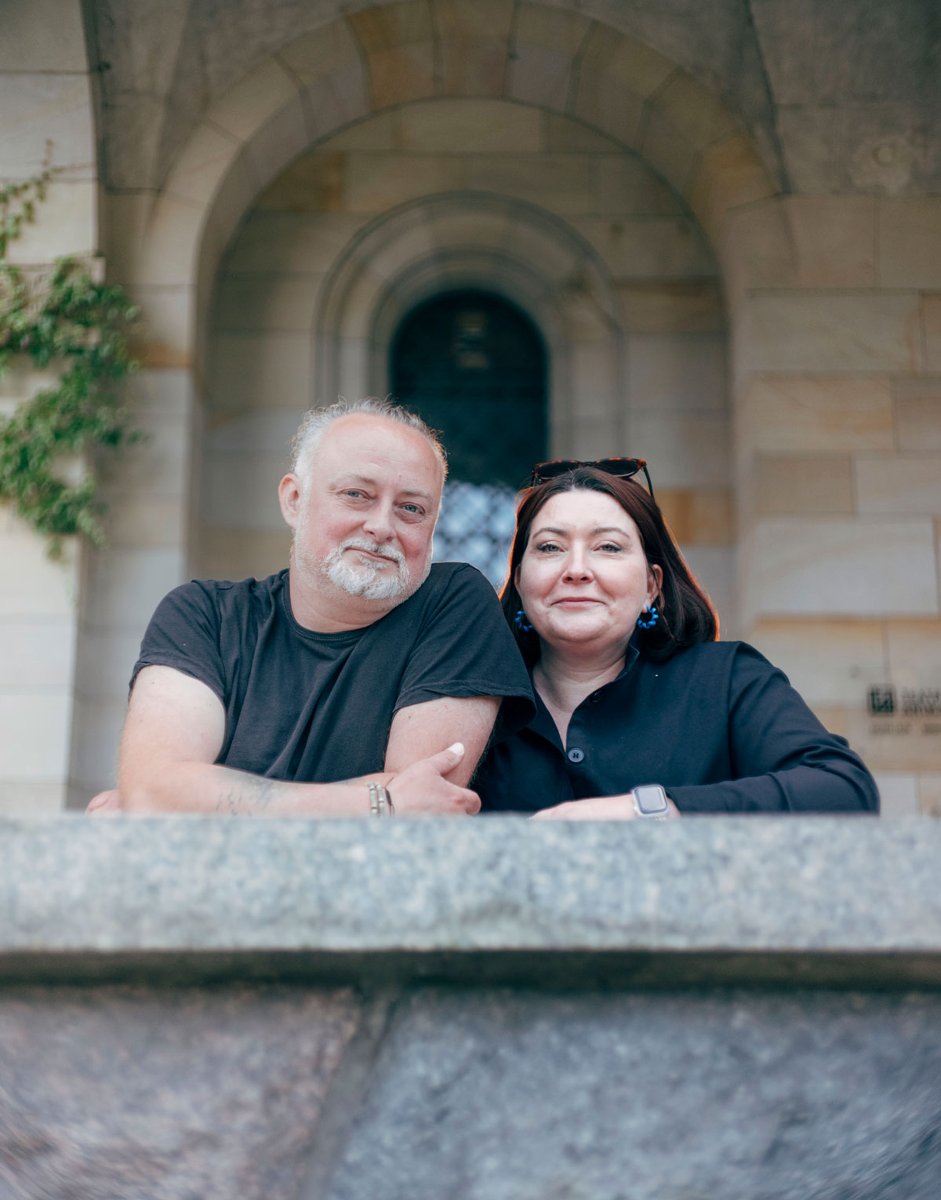


Are you good parents?
Paulina Suszyńska: I'm not sure.
Borys Fromberg: I'm not sure either, but we like to think we are.
Don't you evaluate how well you parent from time to time?
Borys: Our kids are the best judges of that. When they're happy, we feel we're doing a good job, but when they're not, our rating takes a hit.
Paulina: But their happiness isn't solely dependent on us. It's hard to assess ourselves. We definitely make mistakes - our parents did too - but we try not to repeat them.
Borys: And parenting today is completely different from just a few decades, and even one decade ago.
Do you have two children?
Paulina: Yes, we have Kuba, who's twenty-five and has already graduated from university.
Borys: Kuba has been running our restaurant with us since last year; he manages Bo. and seems to enjoy it.
Paulina: It's also an investment in himself because wherever he goes next - like he's considering moving to Spain with his girlfriend - he'll take the skills he's learned here with him. There are pubs and restaurants everywhere.
Borys: And then there's our seventeen-year-old daughter, Laura, who's in high school.
Paulina: Laura was born deaf, which we discovered a few weeks after she was born, and - as you can imagine - we were devastated. After we got back home from the tests, I was drenched in tears, wondering bitterly why this had happened to us. I imagined worst-case scenarios - our child being rejected, sent to special schools, facing immense hurdles. It's hard to admit now, but that's how it felt.
Borys: A deaf child seemed like a sentence to a difficult, unhappy life. It was a bleak outlook.
A picture that slowly started to brighten?
Paulina: Very slowly. A friend told Borys about a facility in Wrocław with a great therapist, Lidia Lempart, who successfully rehabilitated deaf children. We got in touch with her immediately and quickly got Laura fitted with hearing aids to stimulate her residual hearing and prevent her brain from forgetting how to listen, which was crucial if she were to get implants later on.
Borys: Laura and I practiced every day for a half an hour to an hour.
Paulina: The idea is that the more you work with a child's plastic and receptive brain, the better their chances of developing speech and vocabulary.
Borys: We did this after consulting other specialists. We travelled all over Poland - to Warsaw, Gdańsk, and Katowice - often getting conflicting diagnoses, which drove us crazy.
Paulina: On top of that, Laura had heightened muscle tightness, best treated with the Voyta method, which involves pressing specific points on the body to help the nervous system of a several-month-old baby bypass damaged neurons. This had to be done every three hours by a properly trained person under the supervision of a physiotherapist.
Borys: This intense rehabilitation across the board went on until she was six. Additionally, we had bilateral implants put in - one when Laura was one and the other at five, as they can't be implanted simultaneously. As a result, our daughter can hear, speak, sing, and play the guitar perfectly. You'd never guess she was born deaf.
Nice work, both of you!
Paulina: We're very happy it turned out well, but those early years were excruciating. We lived in constant uncertainty and stress as to whether our efforts would pay off.
Borys: And we were always on the road. We had to go to Wrocław twice a week for Laura's therapy sessions.
It must have taken a lot of anxiety, time, and money.
Borys: It did, but we also made many friends along the way, many of whom we're still close with today. We had a lot of fun with both kids and immense satisfaction seeing their progress.
How long have you been together?
Paulina: We're actually celebrating our nineteenth anniversary today. Laura came along two years after we got together because Kuba kept asking for a sibling.
Borys: And we decided to grant his wish.
What kind of education did you choose for Laura?
Borys: She started in a public school, but then we moved her to a private one to ensure she got more individual attention. It wasn't even that Laura needed it badly, but we wanted to tap into all her potential. It was in her best interest, as the school encourages kids to be as self-sufficient as possible.
Paulina: We also wanted to protect her from the kind of bullying that children who are different often face. It was a preventive measure.
Borys: Today, Laura is in the International Baccalaureate programme and is performing outstandingly.
Children's disabilities tend to put a major strain on their parents' relationship, often leading to breakups. Typically, the mother is left to take care of the child alone. How has this affected your relationship?
Borys: Can I take this?
Paulina: Sure, go ahead.
Borys: Whenever problems came up in our relationship, our experience with Laura gave us the confidence that nothing could beat us. And we still believe this today.
Paulina: I also think that fighting for Laura's hearing made it easier to accept her coming out. Neither deafness nor her being transgender are the end of the world, and we can still be a happy family.
Have you ever thought that Laura is doing too much to make your life "interesting"?
Paulina: Absolutely, at some point, I'd had enough. My mum and brother fell ill and died a few years apart. Plus, the pandemic was wreaking havoc on our business. Then Laura told us she was transgender. "When will it ever end?", I asked Borys.
And how did he respond?
Paulina: He said that it all comes to us because we can take it.
Borys: And we did!
Are you Poznań natives?
Paulina: Yes, I'm a proud native of Poznań.
Borys: A model resident, I would say. Paula has a knack for taking advantage of bargains. When, during our holiday in Florence, a baptistery offered free admission to people with disabilities and their guardians, Paula instantly jumped at the opportunity and explored it with Laura.
Paulina: And we didn't have to queue.
Borys: That's what I call Poznań-style money and time management!
Paulina: It's in my genes. My great-grandmother was very enterprising. She ran shops in Poznań and made quite a fortune. She owned the tenement house on ul. Kościuszki in which we are living and two others. After the war, everything was taken away from her and nationalised, and we didn't get it back until communism fell.
Borys: And although my great-grandfather rests in the Poznań Cemetery of Eminent Wielkopolska Residents, I was born in Piła after my parents moved there in the 1970s. My mum traces her family history to Italy and Switzerland, hence my surname, the only one in Poland, originally spelled with a silent "h", i.e. Frohmerg. My father dropped the "h", much to the annoyance of the rest of the family. I moved to Poznań to study after a year in Szczecin, following my mum's advice, who kept telling me I should return to Poznań. And she was right, this is where I belong.
You worked in the City Hall for a decade, rising to the position of deputy director of the City Promotion Office. But then you left to start a restaurant business with Paula, didn't you?
Borys: At that time, Paula and her partner ran Ptasie Radio on ul. Kościuszki and decided to open a second restaurant in the Castle. She put in a bid in a competition and was selected, which is how Świetlica came to be. We agreed that if she succeeded, I would quit my city job because, firstly, I didn't want to be accused of a conflict of interest, the Castle being a city institution, and secondly, running two restaurants was a challenge that required two people.
Paulina: Today, Ptasie Radio is in the hands of my partner because we decided to go our separate ways. We also bid farewell to Świetlica and started Bo., also on ul. Kościuszki, as you might expect, which we're running to this today.
Was Laura's coming out a big surprise?
Paulina: Honestly, no, because I already had my suspicions.
What suspicions?
Paulina: It began when I noticed that Laura was shaving her legs, which seemed strange to me because she was still presenting as a boy. I thought, maybe he's gay. Then I came across an article in Twój Styl about parents of transgender children, and I told Borys our son ticked all the boxes. At the time, Laura suddenly became sad, moody, and withdrawn. I said to her, "Listen, I can see that something is bothering you. No pressure, but I'm here for you if you want to talk about it".
What did you say?
Borys: I told Paula not to worry ahead of time. Whatever will be, will be.
Paulina: But that's not how I roll. I need to talk things through, think them over, and prepare myself. That way, if my intuition is right and the child comes to talk to me, I won't say anything foolish.
And?
Paulina: One day, Laura said she would like to talk to me. She told me she was transgender, didn't feel comfortable in her body, and was actually a girl.
How did you respond?
Paulina: I told her we loved her and would always support her, but to give herself time, not rush into anything, think it over, and try it out, because we all have male and female qualities, and they can manifest themselves in different ways.
So, mum knew then. And dad?
Borys: Dad found out from mum and always trusted his children. Since Laura is transgender, my job is to stand by her, that's all. Nothing new there.
This is a very encouraging reaction coming from a father, because statistically fathers are less likely to accept transgender children. Where do you think you got your openness?
Borys: Actually, Paula jokingly asked me if I was gay. I said, "Why are you asking?" She replied, "Because you're always hugging your pals".
Paulina: Borys has a strong feminine side. He has always been very open, spontaneous, and quick to cuddle everyone. So, when Laura came out, he took it in his stride, and I was the one worrying about everything.
Borys: Come on, I just like people!
Paulina: I like people too, but you can't say we came out of this whole situation unscathed. When Laura won a history competition at the end of primary school, which gave her guaranteed admission to a high school of her choice, we took her to Sicily as a reward. Back then, she was only out to us, so I told her to bring women's clothes if she wanted to, because no one knew her there. So, we shopped together and headed to Sicily.
Borys: This was a trying experience for us both because Laura didn't choose a flowing dress with a floral pattern and instead went for the shortest mini skirt, leather, and chains - a very specific style.
Paulina: And because she has a nice body and is quite shapely, she would turn heads walking down the street. I remember being overwhelmed, and both Laura and I cried from all the emotions that came with this big change.
Borys: I guess you have to go through the experience, that's the only way.
Paulina: Then, I remember someone in the street asked me, "Is this a boy or a girl?" After a moment's hesitation, I replied, "A girl". It's a whole process that you go through with your child, confronting the world together.
Have you had any unpleasant experiences in Poznań?
Paulina: Once, Laura went to pick up a pizza ordered under her name, and when she returned, she said that the people working in the pizzeria made fun of her, saying she wasn't Laura but a boy. I called the manager, explained what had happened, and asked her to talk to her workers because this shouldn't happen. She apologised and said she would address the issue with her staff.
Borys: You can't let such situations slide and must respond, if only to prevent them from happening again. It's not necessarily the manager's or owner's fault, and it's not about attacking a particular establishment. It's about raising awareness and educating people.
When did Laura start using her new name?
Paulina: As soon as she came out. I asked her how she would like to be addressed, and she told me to call her Laura.
Did you adjust quickly?
Paulina: It took us a while, but not too long. Laura herself said she would understand if we occasionally slipped up and used her old name by mistake because it's an adjustment.
Borys: Yes, it wasn't just about using her new name but also adjusting to all the feminine forms in the language.
How did your family members, friends, and acquaintances respond to this change?
Borys: Our friends and acquaintances embraced it in no time.
Paulina: Except for one person who took a bit longer. Laura came out to my brother Kuba on his birthday. Kuba and his girlfriend are very supportive; they are Laura's best friends. My family has no issues, even though my sister is a devout Catholic. Borys' mum was quick to accept it and was very supportive of Laura from the get-go. The first thing she said was that she would teach her how to sew. She now brings choice vintage clothes from her youth, and Laura proudly wears them.
Borys: The longest of these stories involves my father, who was the last to find out. Knowing that she would spend a week of her holiday with her grandfather, Laura was very nervous because she had already come out to everyone else and remembering that to her grandfather, she was still his grandson.
Paulina: It was really stressful for Laura, so Borys and I suggested she talk to her grandfather in our presence when he would come to pick her up. But she didn't want that; she went there and told him herself. After some initial turbulence, grandpa and his wife now fully support Laura.
Borys: Each successive coming out transformed her completely. Before, the anticipation weighed heavily on her, making her depressed and unhappy. Afterward, once she was accepted, she would become radiant and joyful. This shows just how much of a burden it is for LGBT+ people to disguise their identities out of fear of how others would react.
How was school after coming out?
Paulina: After winning that history competition I mentioned earlier, Laura was in a comfortable position of being free to choose any school. She decided to stay in her English-speaking Gaudium et Studium school, which is both primary and secondary. She finished primary school as a boy, and no one in her class other than her best friend and teacher knew she was transgender. When she started high school, we went to see the headmaster to discuss the matter. She said Laura would be the school's first trans student but assured us they would do everything in their power to make Laura feel at home and, of course, would use her preferred form of address.
Do you think it is significant that all this is happening in Poznań?
Paulina: Hugely. Sometimes I feel like we are living in a bubble here, with diversity and acceptance that goes beyond what is seen in other cities.
Borys: Poznań has transformed tremendously over the past decade or so and it's plain to see if you walk around the city. Once, when visiting the West, we marvelled at how colourful it was, and now our city is becoming exactly that. Look at how many rainbow flags hang in windows and on balconies, especially in the Jeżyce district, which was the first to come around. Much credit for this particular change goes to Jacek Jaśkowiak, who, as mayor, in a distinct Poznań style, supported the authorities and various other organisations like the Stonewall Group in fostering tolerance. I think the treatment of LGBT+ matters in Poznań is on a whole new level, never before seen in Poland.
Paulina: There's a good reason why main events on the National Day of Transgender Visibility are held in Poznań.
You are members of the Poznań group of parents of transgender children. How did you get there?
Paulina: Laura told me about Ewelina Negowetti, who runs the largest Facebook group for parents of trans people and who asked if I'd like to join. I did, and once there, I found out that Poznań also had a group for parents of trans kids, so I decided to meet them.
How many parents showed up?
Paulina: About ten.
All of them mothers?
Borys: There were fathers too.
Paulina: But they were in the minority.
When was it?
Paulina: Two years ago.
Were there children there as well?
Paulina: Yes, but at the next meeting. Naturally, they quickly broke off and formed their own group called the Transformers.
How old are the Transformers?
Paulina: Their ages range from about fourteen to twenty. Older members, who are in college, eventually move on with their lives.
Do you meet often?
Borys: Generally, once a month.
Do you go to parades?
Paulina: Absolutely. For the last one, we brought a banner that said "You will never walk alone" made by one of the mums.
Borys: We also join the Pol'and'Rock parade. I think every Pole should go there at least once in their lifetime. It's an amazing event that brings together a huge crowd of friendly, smiling people.
Does Laura take hormones?
Paulina: Yes, since late last August. She wanted to start sooner, but as parents, we wanted to take our time and make sure everything was properly diagnosed before rushing into any decisions. After completing the whole procedure, Laura started taking hormones, which caused her breasts to grow, so we got her a bra for St. Nick's.
Borys: She was over the moon and put it on right away.
So the transition is ongoing?
Paulina: Yes, partly with the resources from Poznań, and partly from Wrocław.
Is there anything the city can do to help parents of transgender children?
Paulina: Parents of transgender children need all kinds of help, from information to psychological assistance. The city once funded such a programme, but it was limited to a small number of participants and filled up quickly. It would be great to have such a programme in Poznań available year-round and without caps.
Borys: It's also important to support transgender children, or more broadly, children at high risk of suicide. We need a city programme to systematically support educators and school psychologists, including providing them with the necessary knowledge, as many lack it.
Paulina: Another issue is the cost of diagnosing gender dysphoria and of transitioning. Some parents simply can't afford endless visits to specialists. Some help with this would be greatly appreciated.
Borys: But the most crucial factor is the support and unconditional love of parents. No specialist, no matter how essential, can replace that. I hope this interview shows parents of transgender children that although they are confronted with a big challenge, they must face it and not see it as a misfortune. We're happy and proud of both our son and our daughter.