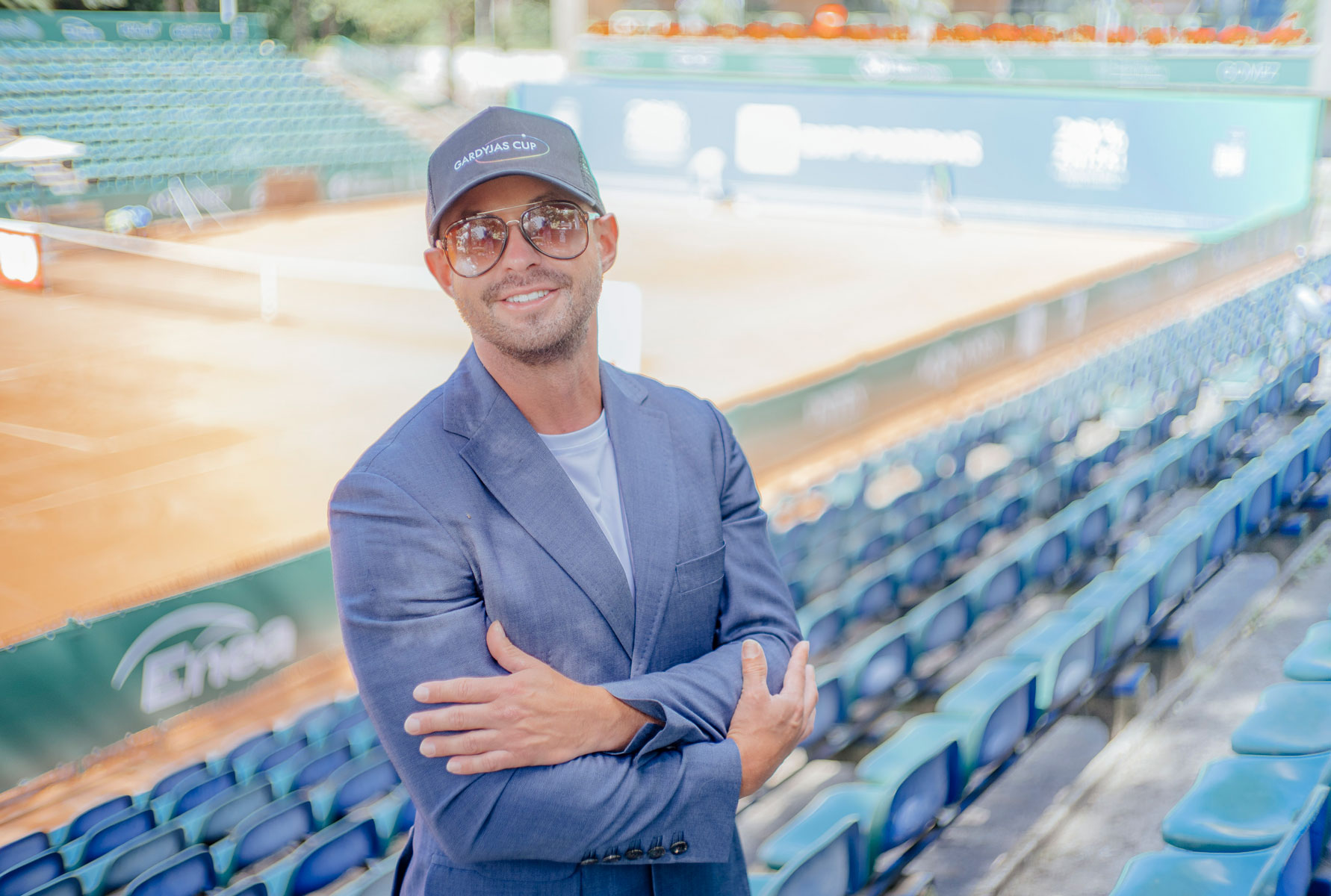


What drew you to tennis in the first place?
Tennis has been a lifelong interest of mine, mainly through following it on TV. After I turned thirty, I think it was while watching the US Open, it occurred to me to give it a shot. I stumbled on a Groupon deal for five lesson, and I snapped it up. That's how it started. I then fell in love with tennis and the feeling was mutual.
Do you still practice regularly?
You could say I'm a recreational player. Tennis is my favourite form of recreation, and at the tournaments I enter tend to get fairly intense, with even several matches in a single day. Needless to say, that only happens if you keep winning and climbing the draw.
How did you become a tournament organiser?
I've always had a flair for organising things, so after playing a few tournaments, I figured I might try running them myself, and maybe even do a better job of it. I wanted to test that. Five years ago, with lads from Warsaw and Katowice, we started Gaybledon. We began with occasional tournaments in Katowice or Warsaw, and more regular ones held annually in Poznań. After a while, we set out on turning them into proper competitions and that's how the Gaybledon Championship Tour came to be, with singles and doubles across five cities. Then came the international GLTA Summer Vibes in Poznań, and next year in Wrocław, we'll be launching Poland's first ever GLTA Winter Vibes.
What is GLTA?
Gay and Lesbian Tennis Alliance, a global organisation whose board I've had the pleasure of joining this year. I'm not only the only Pole, but also the only European serving on it.
Who came up with that brilliant name "Gaybledon"?
Catchy, isn't it? It cropped up about five years ago, just before covid, in chats with a few engaged people. And not everyone loved it at first - some thought it was too in-your-face, and likely to scare off sponsors and venues. I defended it, and - in hindsight - I think I was right. Gaybledon is mainly designed for Polish players. It fills our autumn-winter calendar when far fewer other tournaments are held.
Gaybledon makes it sound like it's for gay men only.
From the outset, we were trying to create a safe space not just for gay men playing tennis, but also for lesbians, who have also faced plenty of discrimination in sports venues. Not everyone lives in friendly Poznań, and not everyone is as lucky as me - I've never had any grief here for being gay. And frankly, I couldn't care less if someone looks at me funny. But the experience of many other people has been very different.
And how is Gaybledon faring today?
Gay men are in still the majority, but no one is barred. We don't check people's orientations - if you want to join in, you're welcome. And it's already happening. Women have joined too, which we deliberately encouraged when applying to host GLTA tournaments. An initial hurdle was that there weren't enough women to fill brackets at all levels, so we held mixed, all-gender draws. But their numbers grew, and that opened my eyes to things I hadn't considered, like the pay gap that discriminated women. Since they earn less, they find it harder to pay tournaments fees - fifteen hundred zlotys for a weekend event turned out to be too steep for many women, but not for men. We had to respond and ensure fairer conditions.
So is everyone playing now?
They are. At this year's Summer Vibes, we managed all five men's singles and five double brackets, plus four out of five women's singles and doubles brackets.
What exactly are those brackets?
GLTA has five brackets, or skill levels: Open (for people nearing professional performance), followed by A, B, C and D. A is advanced, B is intermediate, and so on. Singles and doubles have separate draws. Over ninety tournaments are held per year in locations across the globe ranging from Tokyo to Australia to the Americas to Europe. All results go into the rankings, leading to the World Championships. Last year they were held in Puerto Rico, and Polish women brought home medals.
Were those championships the reason you played a match with Poznań's deputy mayor, Jędrzej Solarski?
That's right. We were raising funds for our female players, and the deputy mayor put himself up for auction. We played, he wiped the floor with me, 0:6, 0:6, but I made him sweat for it, so he didn't win easily.
How many people in Poland are involved in the competitions?
There are roughly a hundred and fifty committed players, both male and female.
From across the country?
Yes, though a few locations, Warsaw, Silesia, and the Tricity, are the main hubs.
Do you also get to play tennis in Poznań's Orion Sports Club, which caters to LGBT+ people?
Certainly, I play there Friday evenings, and I'd encourage anyone, beginner or advanced, to join the Orion tennis section.
A few weeks ago, I ran into you at Lokum Stonewall accompanying a bunch of foreigners. Who were they? What was happening?
They were in town for one of those international Summer Vibes GLTA tournaments I told you about - our third edition. Over 130 people from nearly thirty countries participated, and Lokum - where else? - was chosen to hold our welcome party.
Where did you play the matches?
Poznań's only venue with that kind of capacity is Park Tenisowy Olimpia. It has ten courts in summer but since we needed fourteen, we rented additional courts at the University of Life Sciences. We played from eight in the morning until late at night.
You said earlier that when the name Gaybledon was first coined, some feared organisational problems. Has GLTA Summer Vibes had any issues in Poznań?
None whatsoever. Olimpia has been fantastic from the get-go. It is beautifully maintained and we pay like everyone else. It is exactly how things should work in the civilised world.
What do international visitors make of Poznań?
At the first Summer Vibes, they were floored - they'd expected a grim, homophobic backwater. But they quickly realised Poznań is beautiful, clean, safe, and also compact, with an airport only fifteen minutes from the centre. And crucially, very rainbow-friendly.
Unsurprisingly, we first met not at a tennis match, since I am not into sports, but through a flat rental, since you're an agent by profession.
Yes, a real estate agent, to be clear. It's the only job I can do, to be honest. And I'm told I'm pretty good at it.
I can certainly vouch for that!
Thank you. You could say that my stint in this business has come of age - it's been eighteen years now. What's kept me in it so long and makes me truly enjoy it is the unpredictability. I never know what to expect or who each day will bring. Buying a flat is a once-in-a-lifetime decision for many people, especially with a mortgage, so emotions run high. The challenges and surprises are my driving force. But it's not for everyone. The fact that so few stick it out this long says it all.
Where do people most want to live in Poznań these days?
It varies widely. Some want the buzz of the social scene in trendy Jeżyce, others prefer a quiet estate on the outskirts. Some love old tenements, others prefer modern flats. And the city has changed. When I started in real estate, Jeżyce was where you went if you fancied a punch in the face. Now it's where you go for hummus.
What's the key skill of a good estate agent? Just the gift of the gab?
Being a good listener. You're not looking for a flat for yourself, but for someone else. Knowing property law helps - the rules change frequently. Knowing the city's geography is equally helpful. I'd say I know Poznań like an old cabbie.
And where do you live?
Winogrady, right by the Citadel - and I love it.
Have you always been this open about being gay?
Since I came of age, yes. In my hometown, Strzelce Krajeńskie in Lubuskie, the atmosphere wasn't supportive. My gay life began in Poznań, when I moved here at eighteen to study. I chose logistics and international transport at the University of Economics. After five years, a master's degree in hand, I lasted literally two days in my first job in the profession. A friend suggested real estate, and he was spot on. I did postgraduate studies in real estate trading, as required for what was then a regulated profession, then studied property management and valuation. That was the professional way to do it. Today, it's a free for all and anyone can call themselves an estate agent. Luckily for me, that's not the kind of competition I need to worry about.
Let's circle back to openness.
I came out after my first year at university, to my family as well. I've always been incredibly lucky with the people I met, both personally and professionally. I've never experienced pushback or hostility for being gay, not from my sisters, and cousins, my close or extended family. So yes, I'd call myself a happy gay. A very happy one, in fact.